Platform
Agents & Agent Builder
Not a chatbot that suggests next steps. An agent retrieves the company context it is allowed to see, decides what to do, calls the systems that hold the truth, verifies its own answer, and escalates to a person when the decision is not its to make.
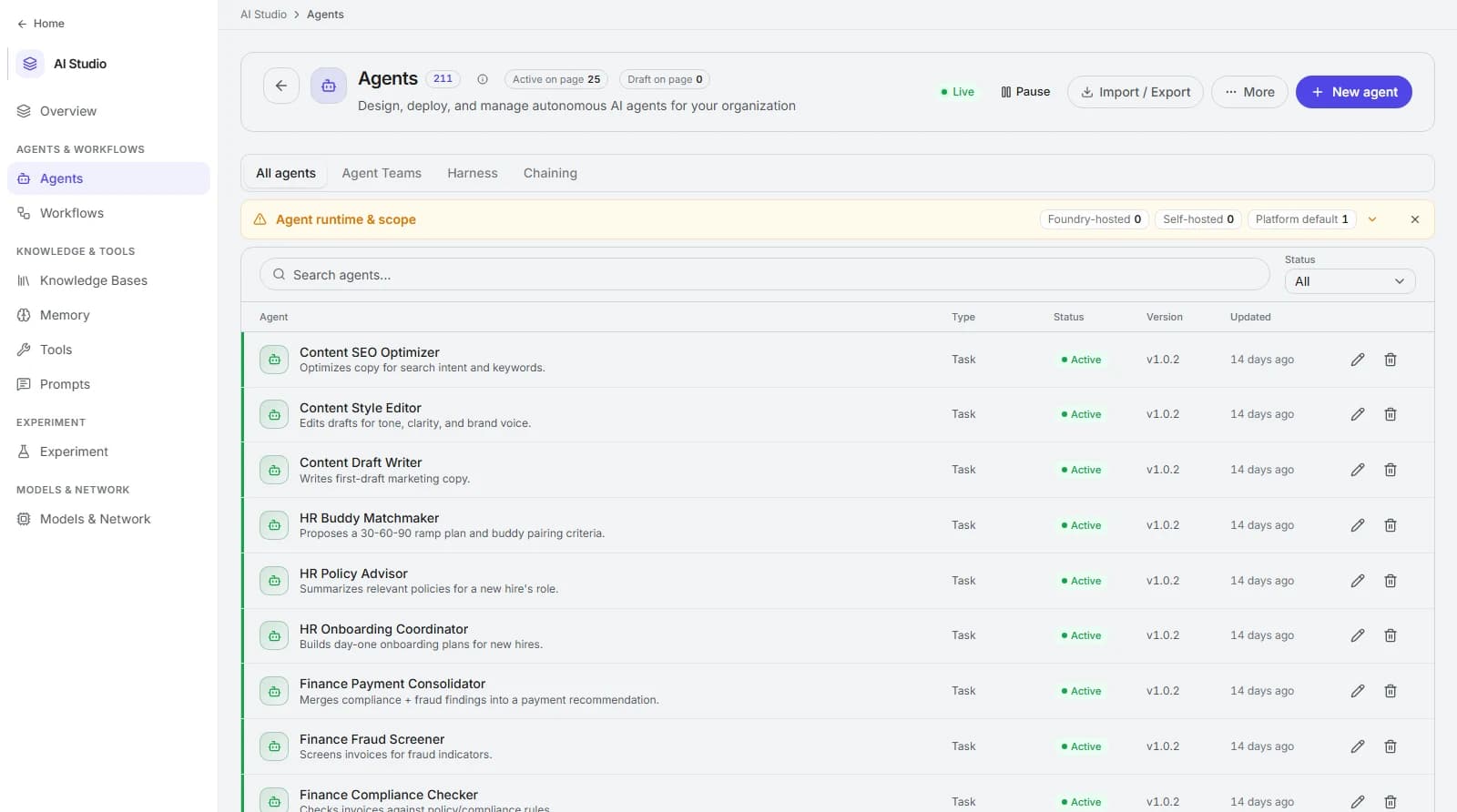
How it works
Building and releasing an agent
Configuration, not a code project. The same five steps apply whether the agent answers questions or closes tickets.
Define the role
Describe what the agent owns, the tone it uses, and the boundary where it must stop and ask.
Capabilities
Agent capabilities
Reasoning is only useful when it is connected. These are the capabilities that turn a model call into an operator inside your business.
Agent Builder
Define an agent’s role, instructions, model policy, knowledge scope, and tool permissions in one configured surface - no release required to change behaviour.
Portal - Build → Agents
Grounded in company context
Agents retrieve from connected knowledge bases and records inside the caller’s permission scope, and answer with citations rather than recall.
permission-filtered hybrid retrieval
Tool use that changes systems
Read and write across the tools your teams already run - tickets, CRM, databases, cloud APIs, internal services - through a safe tool registry.
registry - MCP-compatible tools - custom HTTP tools
Memory across turns and sessions
Conversation state, task scratchpads, and durable memory let an agent pick up a long-running case instead of restarting from a blank prompt.
short-term + persistent memory
Multi-agent collaboration
Route work to specialists under a supervisor pattern, or let a deep agent decompose a broad research task into sub-tasks it manages itself.
supervisor - specialists - deep agent
Handoff to workflows
When a request needs a durable multi-step process, the agent hands off to a workflow rather than improvising a long chain of tool calls.
agent node ↔ workflow orchestration
Guardrails on every turn
Input and output policy, PII handling, spend limits, and per-tool authority are enforced server-side - an agent cannot be prompted out of its permissions.
policy evaluated per request
Escalation with context
Low confidence, failed verification, or a restricted action routes to a named human with the transcript, sources, and intended action attached.
approvals queue - human-in-the-loop
Deploy anywhere people work
Expose an agent in the Portal, embed it in your own product, or call it from an API or a scheduled job - same definition, same governance.
Portal - embed - REST API - SDKs
Patterns
Common agent patterns
Choosing the right shape matters more than prompt craft. These are the patterns teams settle on, and where each one is the right answer.
- Single-purpose agent
- One clear job with a narrow tool set - refund eligibility, access requests, invoice queries. Easiest to evaluate, fastest to trust, usually where the first ROI case lands.
- Supervisor with specialists
- A router agent classifies intent and delegates to domain agents that own their own knowledge and tools. Keeps prompts small and makes each specialist independently testable.
- Deep agent for open-ended work
- For research and analysis tasks with no fixed path: the agent plans, works through sub-tasks, keeps notes, and reports back with sources. Suited to long-running investigative work.
- Agent inside a workflow
- An agent node handles the judgement step - classify, extract, draft, decide - while the workflow owns sequencing, retries, approvals, and state. The most common production shape.
- Human-in-the-loop agent
- The agent prepares the work and a person approves it. Correct default for anything that spends money, touches a customer record, or carries regulatory weight.
- Embedded / programmatic agent
- Called from your own application, a webhook, or a scheduled job through the API and SDKs, with the same workspace separation, guardrails, and tracing as in-Portal use.
Questions
Agents FAQ
Agents absorb the research and system-hopping that dominates handling cost.
cost per task
per-run model + tool cost against resolved-outcome count
Requests closed by the agent without escalating to a specialist queue.
tasks deflected
resolved-without-escalation events on the trace
Time recovered on triage, lookup, drafting, and status chasing.
Hours saved
baseline task time × completed runs
Complete context on turn one instead of a handoff chain.
First-contact resolution
single-session completion rate per agent
Faster only counts if it is also correct and in-policy.
Answer quality
grounding and task-completion evaluation scores
When a human is needed, they start informed rather than from scratch.
Escalation quality
escalations carrying transcript + citations
FAQ
Frequently asked questions
What stops an agent from taking an action it should not?
How do we know an agent is good enough to release?
Do agents replace workflows?
Which models can agents use?
Can non-engineers build agents?
Related capabilities
Explore the rest of the platform
Action
Workflows
Durable DAG execution for multi-step business processes, with branching, retries, and human approvals.
Judgment
Guardrails & Governance
Policy enforcement, PII handling, RBAC, tenant isolation, and audit trails on every request and action.
Self-awareness
Observability
Traces, evaluations, quality monitoring, and cost/latency/token analytics across every run.
See Bhogar on your own data
Book a 45-minute working session. We connect one of your sources, build one agent, run one governed workflow, and review the trace together.