Solution · IT & internal helpdesk
IT & internal helpdesk
Password resets, access requests, licence questions, and device issues follow known paths. Connect your identity, asset, and knowledge systems into one platform and most of them resolve in the chat where they were raised.
ROI lever
Ticket deflection and time-to-resolution
Internal IT has a harsher economics problem than customer support: every minute an employee waits for access is paid twice - once for the service desk and once for the blocked employee. Deflection removes the ticket entirely; time-to-resolution shortens the ones that remain. Together they set both the cost of the function and the productivity tax it imposes on everyone else.
Reads from
- ITSM & ticket history
- Identity & groups
- Assets & licences
- IT policy & guides
The problem
The service desk is a queue in front of a set of known answers
IT already documents how to handle its highest-volume requests. The cost is not in deciding what to do - it is in a human reading a ticket, checking three systems, and doing it.
Checked by hand today
- ITSM tickets & queues
- Identity & access directory
- Asset & device inventory
- Software licence records
- IT policies & how-to guides
- Vendor & support contracts
“Do I already have access to this, and if not, who has to approve it?”
High volume, low variety
Access, password, licence, and device requests dominate the queue. They are well understood and heavily documented, and they still consume the majority of service-desk capacity.
The intranet is where answers go to die
Policies and how-to guides exist across an intranet, a wiki, and a shared drive, with three versions of the same page. Employees stop searching and raise a ticket instead, which is rational behaviour.
Waiting costs more than the ticket
A new starter without system access is expensive on both sides of the ledger. Service-desk cost is measured; blocked-employee cost usually is not, which is why it never gets fixed.
How Bhogar helps
How Bhogar supports it & internal helpdesk teams
Answering is only half of internal IT. Bhogar reads your policy and knowledge sources, checks live entitlement and asset state, and executes the fulfilment step under existing approval rules.
Sources
- ITSM & ticket history
- Identity & groups
- Assets & licences
- IT policy & guides
Outcomes
- Self-service answer
- Provisioned access
- Routed approval
- Enriched incident
Answers from current IT policy
Retrieval spans the intranet, wiki, and runbooks with recency and ownership applied, so employees stop receiving a policy that was superseded two recompanys ago.
How it works →Live entitlement and asset context
Group membership, licence assignment, device state, and open incidents are checked before answering, so the response reflects this employee rather than the general case.
How it works →Agents that fulfil the request
Group membership, licence assignment, and password or MFA resets are performed as safe tool calls in your identity and ITSM platforms - the request is closed, not explained.
How it works →Approval where risk sits
Privileged access, regulated systems, and cost-bearing licences route to the correct approver with the justification and current entitlement attached.
How it works →
All your data
What Bhogar connects for IT
Deflection without live state produces confident, useless answers. The identity and asset systems are what turn "here is the policy" into "this is done".
Service management
Tickets, request catalogue, resolution history, and SLA targets from ServiceNow, Jira Service Management, or equivalent.
Identity & access
Directory groups, roles, entitlements, and joiner-mover-leaver state from Entra ID or your IdP.
Devices & assets
Endpoint inventory, compliance posture, warranty, and assignment records from MDM and asset tooling.
Software & licences
Entitlements, seat counts, renewal dates, and approval owners for each application.
Policy & knowledge
Acceptable use, security standards, onboarding runbooks, and how-to guides across intranet and wiki.
Vendor support
Contracts, escalation paths, and support entitlements for the systems IT does not own.
Governance built in
- Provisioning runs through your identity platform, inheriting existing approval chains - Bhogar requests, it does not bypass.
- Privileged and regulated access is excluded from unattended fulfilment by policy, regardless of how a request is phrased.
- Employee data in prompts and traces is minimised and masked, with retention configured per your internal policy.
- Every fulfilment records requester, approver, action, and justification, so access reviews start from a complete trail.
The workflow
An access request, resolved in the chat it was raised in
The highest-volume internal pattern. Onboarding, licence assignment, and device troubleshooting follow the same shape with different tools attached.
Request is raised
An employee asks for access in chat, the portal, or email. Intent, target system, and urgency are classified on arrival.
In the portal
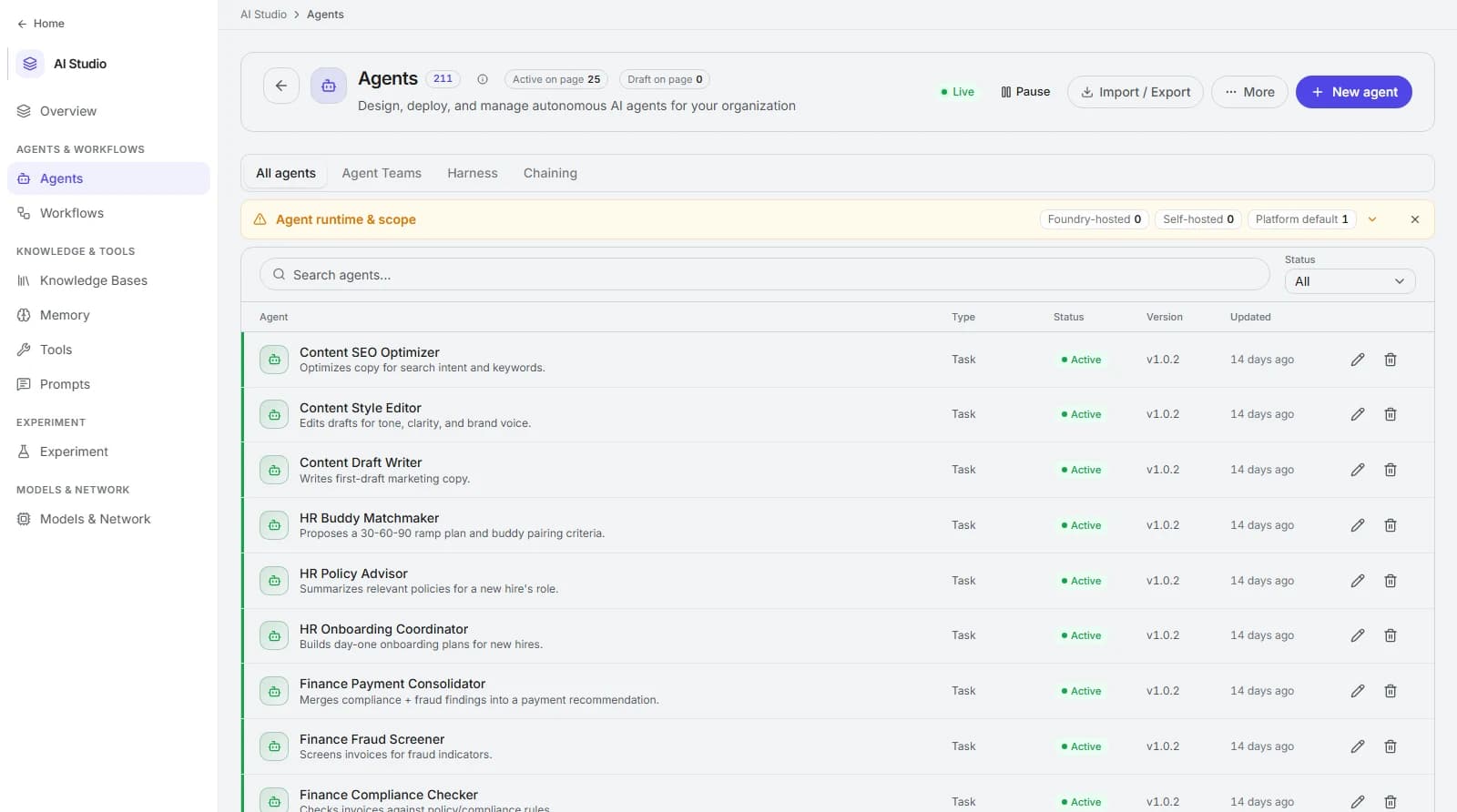
Task agents with a defined job, versioned.
211 agents across content, HR, and finance - each with a type, status, and version, grouped into teams and chains.
The return
How internal IT value is calculated
Report both sides of the ledger. Service-desk savings alone understate the case, because the larger number is usually the productivity recovered from people who stopped waiting.
Ticket deflection
requests resolved without service-desk staff ÷ total requests
The primary lever. Measured per request type, since blended deflection hides which category still costs you.
Time to resolution
request raised → access granted or issue closed
The employee-facing number. Report the median and the tail, because the tail is what people remember.
Employee time recovered
waiting hours avoided × loaded employee cost
Usually the largest line in the model, and the one most often left out of an IT business case.
Cost per ticket
(service-desk cost + platform cost) ÷ closed tickets
Keeps the model honest by carrying platform spend, and lets you compare against your current baseline directly.
| Dimension | Before | With Bhogar |
|---|---|---|
| Access request | Ticket raised, queued, triaged, then fulfilled a day later. | Entitlement checked and standard access provisioned in the same conversation. |
| Policy question | Three intranet versions and a ticket to find which one is current. | A cited answer from the owned, current source. |
| New starter onboarding | A checklist worked by hand across five systems. | Role-based provisioning executed as a workflow, exceptions flagged. |
| Access review | Evidence assembled from ticket notes and memory. | Every grant traced to requester, approver, and justification. |
FAQ
Frequently asked questions
Can it grant access on its own?
Our intranet content is a mess. Is that a blocker?
How does this fit with our ITSM platform?
What stops an employee from talking their way into access?
How quickly does deflection show up?
Keep exploring
HR & people
Get new starters productive sooner and let employees answer their own policy questions - without HR reading the handbook aloud.
Customer support
Resolve repeat contacts without a human touch, and hand agents the full account picture on the ones that still need judgement.
Sales & revenue
Compress the days deals spend waiting on internal answers, and attribute pipeline movement to the work that caused it.
Find the request types that should never reach a human
Bring 90 days of service-desk data. We will rank request types by deflection potential and show which need identity integration to close automatically.