Solution · HR & people
HR & people
A new starter waits on access, equipment, and answers held by five teams. Connect those systems into one platform and the sequence runs itself - while employees get consistent policy answers without opening a case.
ROI lever
Onboarding time and self-service rate
People teams are measured on two things they rarely control end to end. Onboarding time is how long a new starter takes to become productive, and it is lost to sequencing and waiting rather than to training. Self-service rate is the share of employee questions answered without an HR person, which decides whether the team spends its week on policy lookups or on the work only people can do.
Reads from
- HRIS records
- Policy & handbook
- Payroll & benefits
- Learning & compliance
The problem
HR carries the company’s question load
Policy is written down, and it is still faster for an employee to ask a person. That gap is where a people team’s week goes, and it is the same gap that makes onboarding unpredictable.
Checked by hand today
- HRIS employee records
- Policy handbook & addenda
- Payroll & benefits systems
- Onboarding checklists
- Learning & compliance records
- Manager and HR email threads
“What applies to me, in my location, on my contract - and is my new starter actually ready?”
The handbook does not answer the real question
Employees ask about their situation: their notice period, their leave balance, their location’s rules. A generic policy page cannot answer that, so it becomes a message to HR.
Onboarding depends on five teams staying in step
IT provisions, facilities ships equipment, payroll enrols, the manager plans the first week. Nobody owns the sequence, so a single late step quietly delays productivity by days.
Consistency is a compliance risk
When answers depend on which HR partner replies, two employees in the same situation can receive different guidance. That is a fairness problem before it is an efficiency problem.
How Bhogar helps
How Bhogar supports hr & people teams
Bhogar reads your policy set with jurisdiction and contract type applied, checks the employee record, and drives the onboarding sequence across the teams that own each step.
Sources
- HRIS records
- Policy & handbook
- Payroll & benefits
- Learning & compliance
Outcomes
- Personalised answer
- Sequenced onboarding
- Raised service request
- Escalation to HR
Personalised policy answers
Location, contract type, tenure, and entitlement are applied before answering, so an employee receives the clause that governs them rather than the global default.
How it works →Onboarding as an runrchestrated workflow
Access, equipment, payroll enrolment, and manager tasks run as a sequenced workflow with dependencies and owners, so a blocked step is visible on day one instead of week two.
How it works →Agents that complete people work
Raising the IT request, scheduling the check-in, chasing the outstanding compliance module, and preparing the letter - the coordination tail, executed.
How it works →Sensitive by default
Employee data is minimised and masked, and topics such as grievance, health, and performance are routed to a person rather than answered by an assistant.
How it works →
All your data
What Bhogar connects for people teams
Employee questions are personal by nature. The answer is only useful when policy is read together with the record that says which policy applies.
Core HR records
Employment status, location, contract type, manager, and tenure from Workday, SAP SuccessFactors, or your HRIS.
Policy set
Global handbook plus country and entity addenda, with effective dates and the owner of each clause.
Pay & benefits
Leave balances, benefit elections, and payroll calendars that turn a policy question into a specific answer.
Onboarding & offboarding
Checklists, role-based provisioning templates, and the dependencies between IT, facilities, and payroll.
Learning & compliance
Required training, certification status, and completion deadlines by role and jurisdiction.
Case history
Previous HR cases and their resolutions, so precedent is retrievable without exposing personal detail.
Governance built in
- Employees can reach only their own record - retrieval enforces HRIS permissions, and managers see their team scope, nothing wider.
- Grievance, health, performance, and investigation topics are excluded from automated answers and routed to a named person.
- Special-category personal data is minimised in prompts and traces, with retention and residency set per jurisdiction.
- Policy answers cite the clause and its effective date, so guidance is consistent and defensible when it is challenged.
The workflow
A new starter, ready on day one
Onboarding is the clearest people-team workflow because every step already has an owner. What is missing is something holding the sequence together.
Hire is confirmed
A signed offer creates the employee record with role, location, entity, and start date - the inputs every downstream step needs.
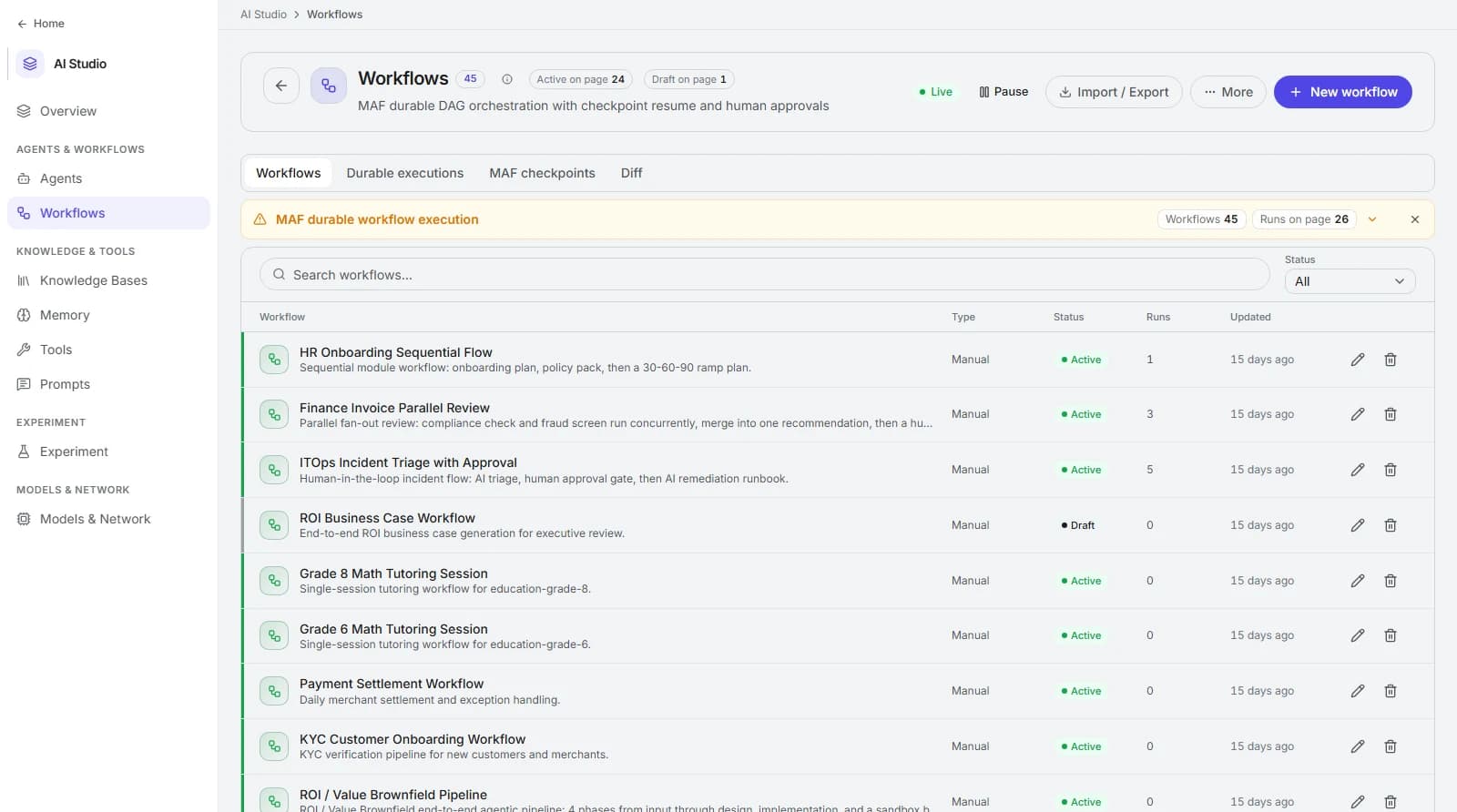
In the portal
Durable workflows with approvals built in.
Multi-step processes - onboarding, invoice review, incident triage, KYC - run as checkpointed DAGs with human approval gates.
The return
How people value is calculated
People metrics attract scepticism because they often measure activity. These are outcome measures, taken from HRIS and provisioning timestamps rather than from a survey.
Onboarding time
start date → first independent contribution in role
The primary lever. Define the milestone per role family before rollout so the comparison stays honest.
Self-service rate
employee questions resolved without HR involvement ÷ total questions
The second lever, and the one that returns the people team’s week to work only humans can do.
Day-one readiness
starters with access, equipment, and payroll complete on day one ÷ all starters
The leading indicator. It moves first and it predicts the onboarding-time result.
HR case volume
cases raised per 100 employees per month
Watch alongside self-service rate - falling cases with rising escalations means answers got worse, not better.
| Dimension | Before | With Bhogar |
|---|---|---|
| Policy question | A message to HR, answered in a day, sometimes inconsistently. | A personalised answer citing the clause that applies to that employee. |
| Onboarding coordination | A checklist chased manually across five teams. | A sequenced workflow with owners, lead times, and visible blockers. |
| Manager preparation | The manager improvises the first week. | A role-based plan with tasks raised and check-ins scheduled. |
| Compliance tracking | Chased by spreadsheet before an audit. | Tracked continuously with reminders routed to the right person. |
FAQ
Frequently asked questions
Can employees see each other’s data?
What about grievances, health, or performance conversations?
We operate in several countries with different rules. Does that work?
Does this replace our HRIS?
How do we measure onboarding time credibly?
Keep exploring
Customer support
Resolve repeat contacts without a human touch, and hand agents the full account picture on the ones that still need judgement.
Sales & revenue
Compress the days deals spend waiting on internal answers, and attribute pipeline movement to the work that caused it.
Engineering
Give engineers back the hours lost to archaeology - finding why a system behaves this way, who owns it, and what already broke before.
Make day-one readiness the number you report
We map your onboarding sequence across the owning teams, show where the waiting is, and define the productivity milestone the ramp is measured against.