Solution · Finance
Finance
Reconciliations, accruals, and variance explanations all depend on documents and context living outside the ledger. Connect them into one safe platform and the first week of the month stops being an archaeology exercise.
ROI lever
Close time and cost to serve
Finance runs on two clocks. Close time is the days from period end to reported numbers, and it is consumed by chasing explanations rather than by accounting judgement. cost to serve is the fully loaded cost of processing a transaction - an invoice, an expense, a collection. Both improve when evidence gathering stops being a manual search.
Reads from
- ERP & ledger
- Invoices & statements
- Contracts & POs
- Bank & payments
The problem
Finance spends the close explaining, not deciding
The ledger knows what happened. It rarely knows why. Every unexplained variance turns into an email thread, and those threads are the critical path of your close calendar.
Checked by hand today
- ERP & general ledger
- AP invoices & statements
- Contracts & purchase orders
- Bank & payment records
- Expense reports & receipts
- Vendor email threads
“Why did this account move this month, and where is the document that proves it?”
Every variance becomes an investigation
A number moves, and someone has to find the purchase order, the contract clause, and the operational event behind it. The accounting takes minutes; the search takes days.
Supporting evidence lives outside the ledger
Contracts, statements of work, vendor correspondence, and approvals sit in document stores and inboxes. Auditors ask for them, controllers hunt for them, and nobody has an index.
Transaction processing scales linearly
Invoice coding, expense review, and collections follow-up grow with volume. Add a business unit and you add headcount, because the cost per transaction has not changed in years.
How Bhogar helps
How Bhogar supports finance teams
Bhogar joins ledger movement to the operational and contractual context that caused it, then drafts the explanation with its evidence attached - so a controller reviews rather than researches.
Sources
- ERP & ledger
- Invoices & statements
- Contracts & POs
- Bank & payments
Outcomes
- Drafted variance note
- Coded transaction
- Matched exception
- Audit evidence pack
Variance explanations with evidence
Account movements are matched to the transactions, contracts, and operational events behind them, and drafted as an explanation a reviewer can accept, amend, or reject.
How it works →Document understanding at volume
Invoices, statements, and contracts are read and coded against your chart of accounts and cost centres, with the source line kept for every field.
How it works →Agents for the transaction tail
Three-way match exceptions, duplicate detection, collections follow-up, and vendor queries are handled as executable work rather than a list somebody works through.
How it works →Controls that stay intact
Approval limits, segregation of duties, and journal posting rules are enforced by the platform, and every automated action is traced to a named policy.
How it works →
All your data
What Bhogar connects for finance
Finance already has the numbers. What it lacks is a fast, permissioned path from a number to the document and decision that explain it.
General ledger
Journals, sub-ledgers, trial balance, and period comparatives from your ERP.
Accounts payable
Invoices, vendor statements, credit notes, and the coding history behind similar spend.
Commitments
Contracts, purchase orders, statements of work, and renewal terms that drive accruals.
Cash & banking
Bank statements, payment runs, and settlement records for reconciliation.
Employee spend
Expense claims, receipts, and corporate card feeds, with policy applied consistently.
Operational context
Headcount changes, usage volumes, and project milestones that explain why a cost line moved.
Governance built in
- Segregation of duties is preserved - an agent may prepare and propose, but posting and approval remain with authorised people.
- Approval limits and delegation of authority are enforced as configuration, and every exception is recorded.
- Every generated explanation carries its supporting documents, so an auditor follows a link instead of opening a request.
- Retention, access, and residency follow your existing finance data policy, including region-pinned model routing.
The workflow
A month-end variance, from flag to sign-off
The close pattern most controllers recognise. The same shape covers accrual review, intercompany reconciliation, and audit evidence requests.
A variance is flagged
An account moves beyond its tolerance against prior period, budget, or forecast, and enters the close checklist.
In the portal
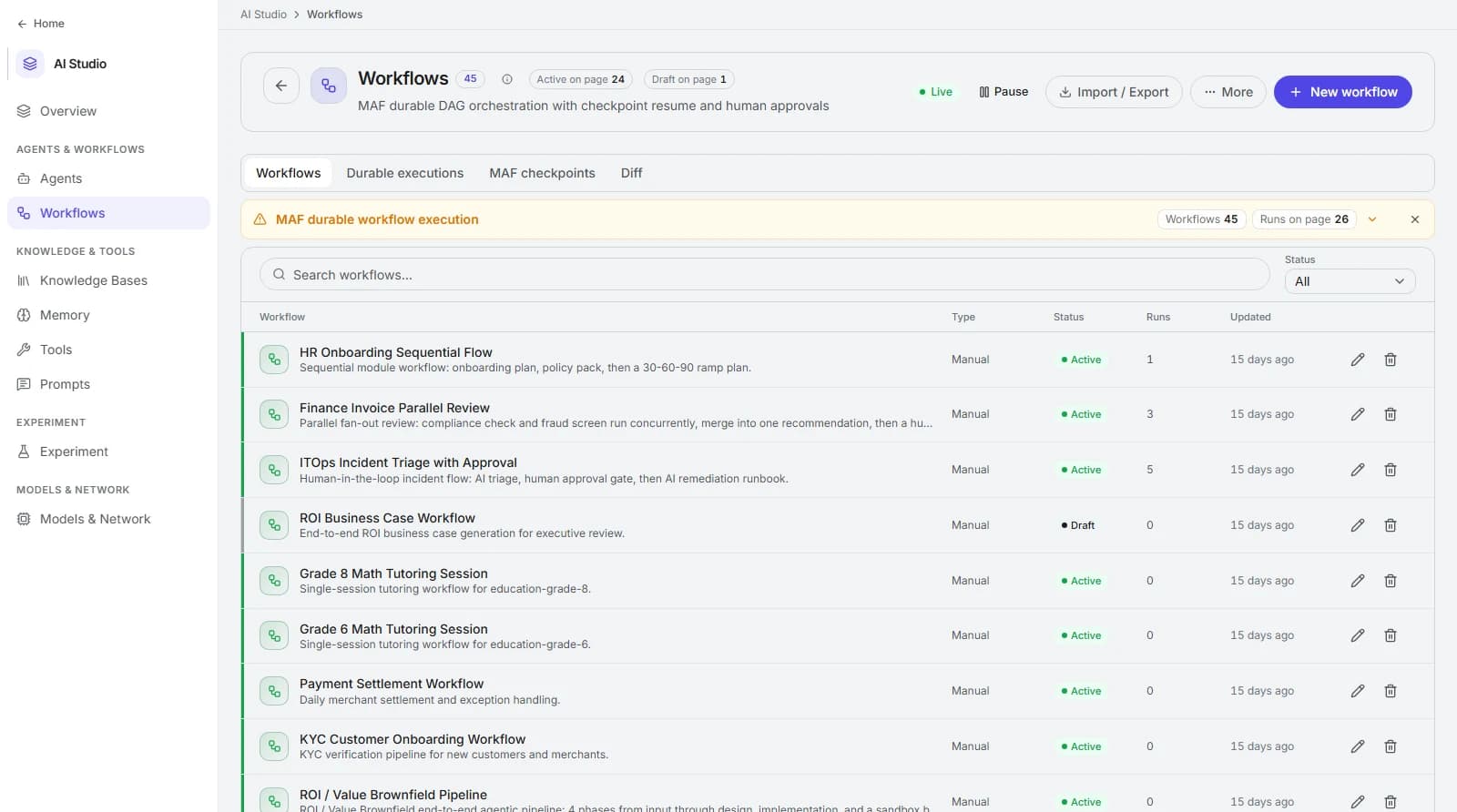
Durable workflows with approvals built in.
Multi-step processes - onboarding, invoice review, incident triage, KYC - run as checkpointed DAGs with human approval gates.
The return
How finance value is calculated
Finance will audit this model before it believes it, which is the right instinct. Every metric below is derived from timestamps and cost data your team already reports.
Days to close
period end → numbers reported and signed off
The primary lever. Track the critical path, since a faster non-blocking task changes nothing.
cost to serve
(loaded process cost + platform cost) ÷ transactions processed
Reported per process - invoice, expense, collection - because blended numbers hide the outlier that matters.
Touchless processing rate
transactions completed with no manual intervention ÷ total
The clearest leading indicator of cost to serve, and the easiest to verify against ERP data.
Evidence retrieval time
audit or query raised → supporting documents produced
Rarely tracked, consistently painful, and the fastest metric to improve once documents are indexed.
| Dimension | Before | With Bhogar |
|---|---|---|
| Variance explanation | Two days of email threads to explain one account movement. | A drafted commentary with linked evidence, ready for review. |
| Invoice coding | Manual coding against precedent held in an experienced clerk’s head. | Coded from contract terms and historical treatment, with confidence and source shown. |
| Audit request | A scramble across shared drives, inboxes, and the ERP. | An evidence pack assembled from the indexed source of record. |
| Cost reporting | Cost per transaction estimated once a year for a business case. | cost to serve reported continuously, including platform and model spend. |
FAQ
Frequently asked questions
Will an AI system be posting journals?
How does this satisfy auditors?
Our ERP already has AI features. Why add a layer?
What about accuracy on extracted document values?
Where do most finance teams start?
Keep exploring
IT & internal helpdesk
Resolve access, device, and software requests at the moment they are raised, instead of queueing them behind a service-desk backlog.
HR & people
Get new starters productive sooner and let employees answer their own policy questions - without HR reading the handbook aloud.
Customer support
Resolve repeat contacts without a human touch, and hand agents the full account picture on the ones that still need judgement.
Take a week out of the close, with evidence
Bring your last close calendar and the accounts that always run late. We will show which explanations can be drafted from connected data and how the controls would hold.