Platform
Guardrails, Security & Governance
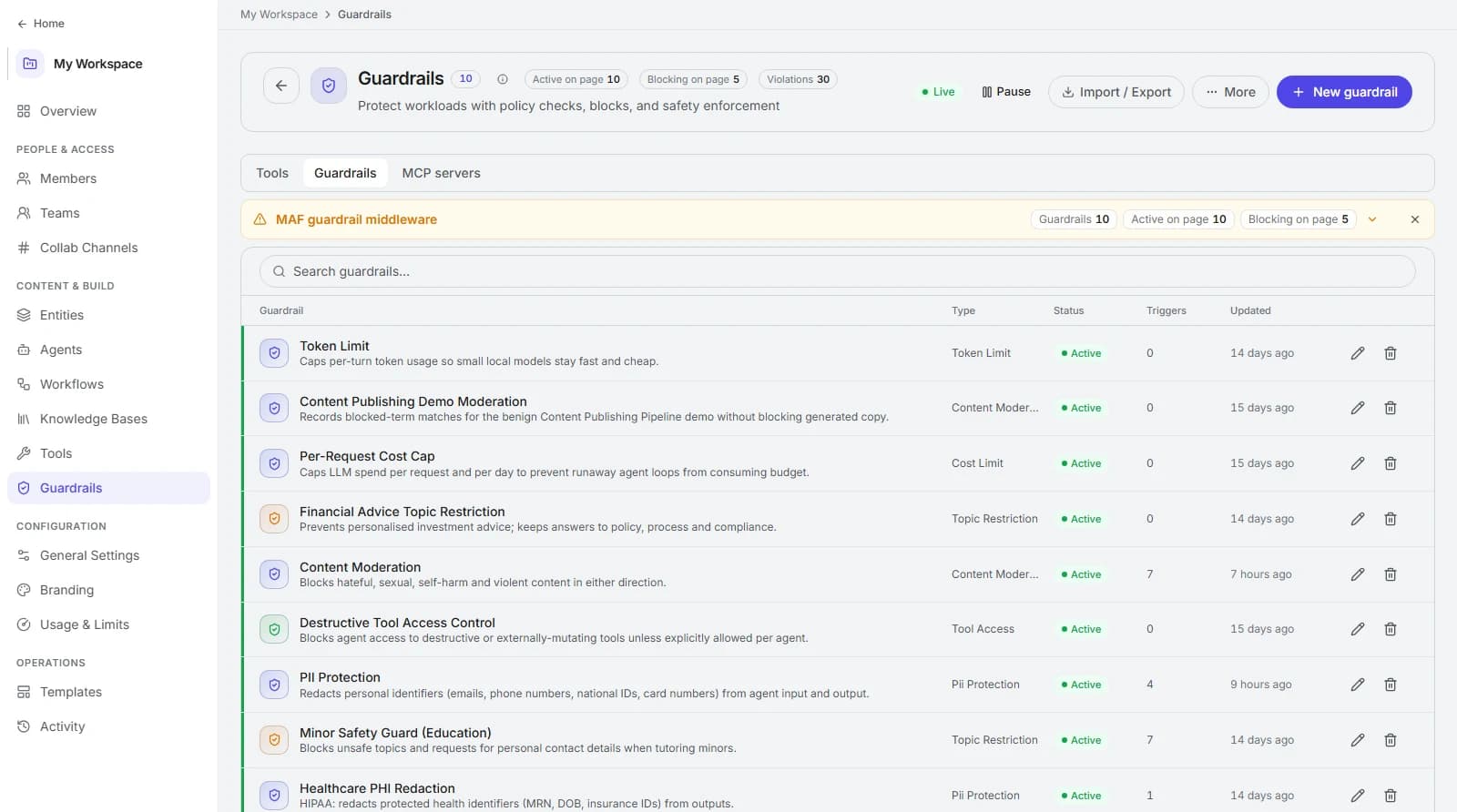
A platform that can act needs to know what it must not do. Guardrails, identity, workspace separation, and audit are evaluated in the runtime on every request - so the answer to “what stopped it?” is a policy decision on a trace, not a hopeful sentence in a prompt.
How it works
Setting up governance
Set up once, enforce continuously, review with real data. Governance work should shrink as coverage grows, not scale with it.
Establish identity
Federate sign-in, enforce MFA, and define the roles and workspaces that mirror how your organization is structured.
Capabilities
Governance controls
Governance is not a settings page. It spans identity, workspace separation, retrieval, action authority, spend, and evidence - and all of it has to hold at runtime.
Runtime guardrail policies
Input and output policies are evaluated server-side on every request - content rules, prompt-injection screening, grounding requirements, and refusal behaviour.
Portal - Observe → Governance
PII detection and handling
Detect sensitive fields and choose per data class whether to redact, mask, or block - before the content reaches a model or a log.
redact - mask - block
RBAC across every surface
One permission model governs retrieval, tool calls, mutations, and reporting. Roles and module access are evaluated on the same predicate everywhere.
roles - module access - workspace scope
Multi-tenant isolation
companies and workspaces separate data and execution at the platform level, so no agent, index, or trace crosses a tenant boundary.
org + workspace primitives
Enterprise identity
SSO through SAML and OIDC, Microsoft Entra sign-in, MFA and WebAuthn, device trust, and session controls administered centrally.
SAML - OIDC - MFA - WebAuthn
Spend and rate authority
Budget ceilings, per-route rate limits, and tool-level quotas mean an unattended agent cannot run up an unbounded bill.
budgets - quotas - rate limits
Approval workflows
Sensitive actions require named human sign-off, with the request, its evidence, and the intended action presented to the approver.
human-in-the-loop authority
Audit trail
Policy verdicts, approvals, configuration changes, and access events are retained with the policy version in force at the time.
who - what - when - under which policy
Compliance posture
Governance dashboards, compliance findings, and an auditor view give reviewers evidence without handing them production access.
findings - auditor portal
Design decisions
Our approach to AI governance
These are the choices that decide whether controls survive contact with a determined user or a scaled rollout.
- Policy is server-side, always
- Guardrails that live in a system prompt are suggestions. Bhogar evaluates policy in the runtime, so the same rules apply whether a request arrives from the Portal, an embedded widget, the API, or a scheduled job.
- Permissions are enforced during retrieval
- Filtering after generation is too late - the model has already read the content. Access control is applied while retrieving, so restricted material never enters a prompt in the first place.
- Writes never fail open
- If an authorization check cannot be resolved, a mutating action is refused rather than allowed. Read paths degrade gracefully; anything that changes state does not.
- Authority is granted per tool
- An agent’s ability to act is the union of the tools it was granted, each with its own scope and limits. Widening authority is an explicit configuration change, not an emergent behaviour.
- Human approval is a state, not an email
- Approvals pause a durable run, present the evidence, and record the decision. That is auditable in a way that an out-of-band message thread never is.
- Explainability is the point of audit
- Retaining the policy version, the retrieved sources, and the verdict means you can answer “why did the system do that?” months later - which is what regulators, auditors, and incident reviews actually ask.
Procurement
Resources for security and procurement reviews
Published references for security and legal review - plus a route to a human when a questionnaire needs answering.
Governance evidence exists by default, so review is a read rather than a build.
Time to security approval
policy documentation, audit trail, compliance findings
Blocked and redacted events show controls working instead of hoping they are.
Policy violation rate
guardrail verdict counts by policy and route
Ceilings and quotas convert a runaway-cost risk into a bounded one.
Unbudgeted spend
budget guard events and enforced limits
Faster sign-off when approvers get the evidence with the request.
Approval turnaround
approval wait time per workflow
Answering “what ran, under which policy” takes minutes rather than a project.
Audit response time
retained decisions with policy version
Governance that holds is what allows expansion beyond the pilot team.
Rollout confidence
workspaces enabled without new control work
FAQ
Frequently asked questions
Can a user prompt their way around a guardrail?
How is PII handled?
What identity and access controls are supported?
What compliance documentation is available?
Can we deploy inside our own boundary?
Related capabilities
Explore the rest of the platform
Self-awareness
Observability
Traces, evaluations, quality monitoring, and cost/latency/token analytics across every run.
Outcomes
ROI & Value
Baseline, instrument, and report business value - hours saved, cost to serve, deflection, and payback.
Senses
Data & Integrations
Connect every source - documents, databases, SaaS, tickets, CRM, code, comms, and warehouses - into one safe layer.
See Bhogar on your own data
Book a 45-minute working session. We connect one of your sources, build one agent, run one governed workflow, and review the trace together.