Solution · Customer support
Customer support
Your team already knows the answers. They are just spread across a help centre, three years of resolved tickets, the changelog, and the billing system. BhogarAI connects those into one platform, then lets agents resolve on top of it.
ROI lever
tasks deflected and cost per task
Support economics turn on two numbers: the share of contacts resolved without a human touch, and the fully loaded cost of the contacts that still need one. Bhogar moves both - it answers the repeatable contacts from approved knowledge, and it shortens the rest by assembling account context before an agent opens the ticket.
Reads from
- Help centre & docs
- Resolved tickets
- CRM & entitlements
- Billing & orders
The problem
Support cost scales with volume because knowledge does not scale with the team
Headcount is the only lever most support orgs have, because every contact is researched from scratch by a person who has to reassemble the same context the last person assembled.
Checked by hand today
- Help centre & macros
- Resolved ticket history
- Product docs & changelog
- CRM account records
- Billing & subscription state
- Engineering escalation threads
“Has anyone already solved this exact issue, for a customer on this plan?”
The same question, answered from scratch
A large share of contacts are variations of requests your team has already resolved well. Those resolutions live in ticket history rather than in usable knowledge, so each new one is researched again at full cost.
Answers age faster than the help centre
Every release changes what "correct" means. Macros and articles drift behind the product, agents stop trusting them, and they escalate to engineering instead - which is where your most expensive minutes go.
Context is assembled by hand at first response
Before replying, an agent opens the CRM, the billing record, the order history, and the last three tickets. That assembly work never appears in a dashboard, and it is a large share of handle time.
How Bhogar helps
How Bhogar supports customer support teams
Instead of another chatbot bolted onto the help centre, the same intelligence layer indexes support knowledge, joins it to live account data, and is allowed to finish the work.
Sources
- Help centre & docs
- Resolved tickets
- CRM & entitlements
- Billing & orders
Outcomes
- Self-service resolution
- Drafted agent reply
- Completed account action
- Escalation with context
Grounded answers with citations
Retrieval runs across approved articles, resolved tickets, and product documentation. Every answer carries its sources, so an agent can verify in seconds instead of trusting a black box.
How it works →Full account context at first touch
Entitlement, plan, orders, and recent history are joined into the conversation, so the reply reflects the customer in front of you rather than the average customer.
How it works →Agents that complete the action
Resetting access, resending an invoice, extending a trial, or raising an RMA are tool calls the agent performs - not instructions the customer is asked to follow themselves.
How it works →Policy that holds under pressure
Refunds, credits, retention offers, and regulated wording sit behind guardrails and approval steps, so autonomy never turns into unbounded promises.
How it works →
All your data
What Bhogar connects for support
Deflection quality is a data problem before it is a model problem. These are the sources that decide whether an answer is trustworthy enough to send unattended.
Help centre & macros
Published articles, internal macros, and the tone and escalation rules your team already agreed on.
Resolved ticket history
Years of Zendesk, Freshdesk, Intercom, or ServiceNow resolutions - the real answers, in your own language.
Product documentation
Release notes, changelog, known issues, and the setup guides customers are actually following.
Customer records
Plan, entitlement, seat count, renewal date, and open commitments held in the CRM.
Transactions
Orders, invoices, refunds, and subscription state, so an answer matches the account rather than the documentation default.
Conversation channels
Email, chat, and community threads where the same question arrives in a dozen different phrasings.
Governance built in
- Retrieval inherits source-system permissions - an assistant never surfaces an account a requester could not open directly.
- Personal data is detected and masked in prompts and traces, with redaction rules configured once and applied on every surface.
- Refunds, credits, and contract-affecting changes route through human approval before any tool call executes.
- Answers keep their citations and execution trace, so quality review and audit work from evidence rather than recollection.
The workflow
What actually happens to a contact
The same path runs for chat, email, and help-centre contacts. Autonomy is set per intent, so you can start with drafting and move to unattended resolution when the evidence supports it.
Request arrives
A contact lands in chat, email, or the help centre. Intent, product area, language, and account are classified before anyone opens it.
In the portal
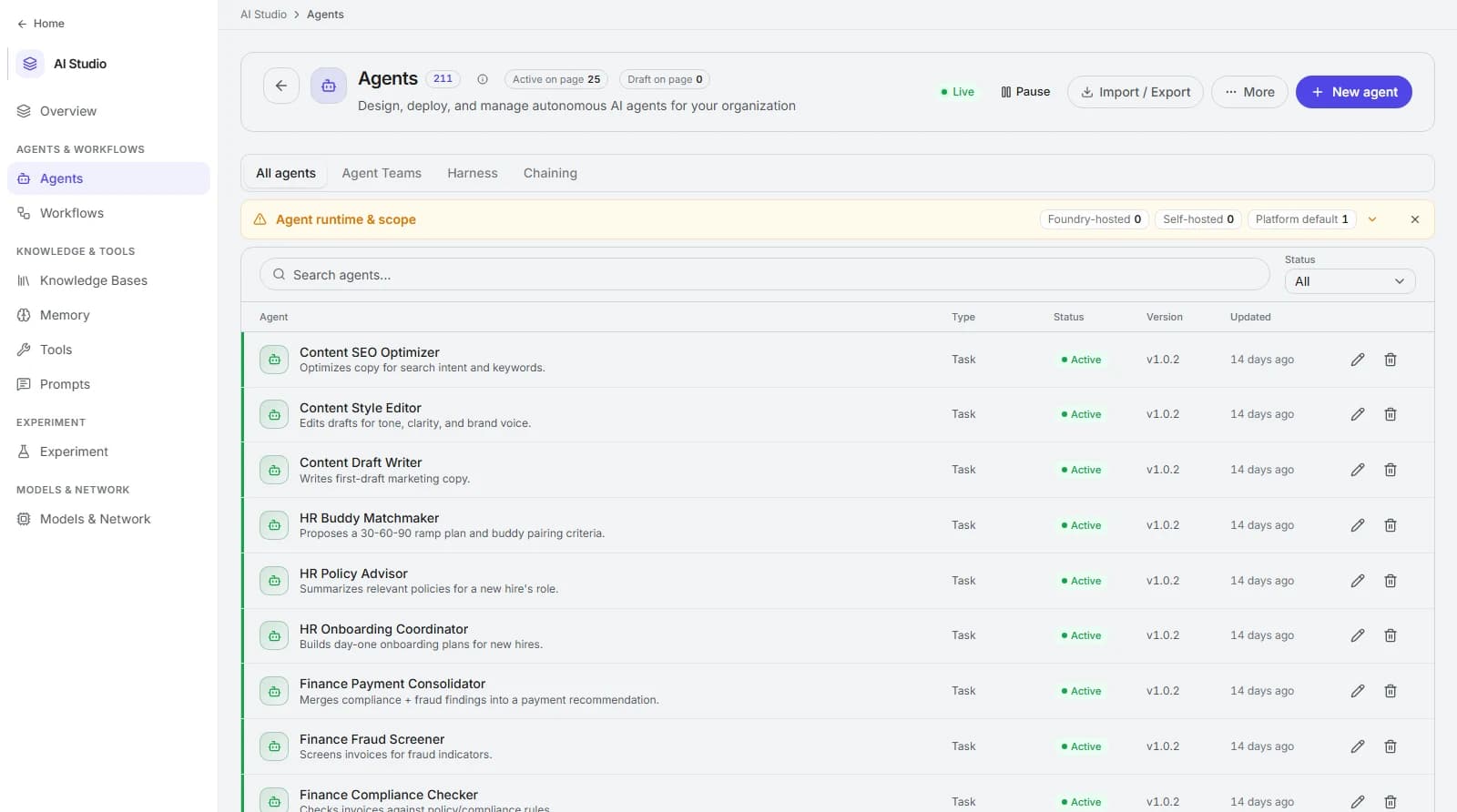
Task agents with a defined job, versioned.
211 agents across content, HR, and finance - each with a type, status, and version, grouped into teams and chains.
The return
How support value is calculated
Baselines come from your own helpdesk export before anything is deployed, and targets are agreed in the same session. The numbers below are the model, not a promise - your Observe data fills them in.
tasks deflected
contacts resolved without human touch ÷ total contacts
The primary lever. Counted only on contacts that stay resolved, so a deflection that bounces back never scores.
cost per task
(loaded agent cost + platform cost) ÷ resolved contacts
Model and platform spend are included, so the figure survives a finance review instead of collapsing under one.
First response time
contact created → first substantive reply
Usually the first metric to move, because context assembly stops being manual on day one.
Reopen rate
reopened tickets ÷ resolved tickets
The guardrail metric. Deflection bought with worse answers shows up here before it shows up in churn.
| Dimension | Before | With Bhogar |
|---|---|---|
| Finding the answer | Agent searches the help centre, gives up, and asks in a team channel. | The approved answer is retrieved with citations the moment the ticket opens. |
| Account context | Four systems opened by hand before the first reply is written. | Entitlement, orders, and ticket history are joined into the conversation automatically. |
| After a release | Macros drift behind the product until customer complaints expose the gap. | New release notes are indexed the same day, so answers change with the product. |
| Reporting value | Deflection is inferred from ticket volume trends and headcount plans. | Deflection, reopens, and cost per task are attributed per workflow in Observe. |
FAQ
Frequently asked questions
How do you stop it answering confidently when it should not?
Do we have to rewrite the help centre first?
What happens with a customer who is already angry?
Can it act in our helpdesk, or only suggest?
How is this different from the AI feature in our helpdesk?
Keep exploring
Sales & revenue
Compress the days deals spend waiting on internal answers, and attribute pipeline movement to the work that caused it.
Engineering
Give engineers back the hours lost to archaeology - finding why a system behaves this way, who owns it, and what already broke before.
Operations
Take the waiting out of multi-step processes - the handoffs, the exceptions, and the checks that only a person could make until now.
Put a deflection number on your own ticket history
Bring a 90-day helpdesk export. We will show which intents are deflectable today, what cost per task looks like against them, and how the first workflow would be safe.