Solution · Engineering
Engineering
Design docs, incident history, service ownership, and the code itself hold the answer to most interrupt questions. Connect them into one platform and the answer arrives in the channel where the question was asked.
ROI lever
Engineering hours saved
Engineering value is measured in hours returned to building. The hours Bhogar recovers are specific and countable: onboarding ramp, incident archaeology, repeat interrupt questions, review of routine changes, and the search time that precedes every non-trivial task. Those hours are recovered from waiting and searching, not from writing code faster.
Reads from
- Code & PR history
- Design & decision docs
- Incidents & runbooks
- Issues & ownership
The problem
The expensive part of engineering is finding out
Writing the change is rarely the bottleneck. Understanding the system well enough to make the change safely is - and that understanding is distributed across systems that do not talk to each other.
Checked by hand today
- Code & repository history
- Architecture decision records
- Incident reviews & postmortems
- Runbooks & internal wikis
- Issue tracker & PR discussion
- Service ownership registries
“Why does this service work this way, who owns it now, and what broke last time we touched it?”
Context is scattered across six tools
The reason a service behaves this way is in an architecture decision record. The last time it broke is in an incident review. Who owns it now is in a spreadsheet that is three reorgs out of date.
Senior engineers are the fallback index
When search fails, people ask the person who was there. Those interrupts are the most expensive lookup path in the company, and they scale with the number of new joiners rather than with the value produced.
Ramp time repeats the same discovery
Every new engineer rediscovers the same landscape by reading the same code and asking the same questions, because nothing captured the previous discovery in a reusable form.
How Bhogar helps
How Bhogar supports engineering teams
Not a coding assistant competing with your IDE. A layer that understands your systems as they actually are - including the decisions and failures that shaped them - and answers where engineers are already working.
Sources
- Code & PR history
- Design & decision docs
- Incidents & runbooks
- Issues & ownership
Outcomes
- Answered in channel
- Incident context pack
- Triaged and routed issue
- Drafted documentation
Answers grounded in your systems
Retrieval spans repositories, decision records, runbooks, and incident history, so an answer about your architecture cites your architecture rather than a plausible general pattern.
How it works →Incident context without the scramble
During an incident, related past incidents, recent changes to the affected services, and the relevant runbook sections are assembled while responders are still joining the call.
How it works →Agents for the routine tail
Drafting release notes from merged changes, triaging inbound issues to the owning team, summarising a decision thread into a record - the work that is always deferred because it never fits in a sprint.
How it works →Boundaries that survive an audit
Repository and system permissions carry through to retrieval, secrets are excluded from indexing, and every answer keeps a trace of what it read.
How it works →
All your data
What Bhogar connects for engineering
Code alone produces confident answers about the wrong thing. The decisions, failures, and ownership around the code are what make an answer safe to act on.
Repositories
Source, commit history, and pull request discussion, including the review comments that explain a trade-off.
Design & decision records
RFCs, ADRs, and architecture docs - the reasoning that the code itself cannot express.
Incident history
Postmortems, timelines, and remediation items, so a repeat failure is recognised as a repeat.
Runbooks & operations
Escalation paths, dashboards, deploy procedures, and the manual steps still hiding inside them.
Work tracking
Issues, epics, and backlog history that show what was tried, deferred, or deliberately dropped.
Ownership & topology
Service catalogues, on-call rotations, and dependency maps that answer "who do I talk to" correctly.
Governance built in
- Repository and workspace permissions are enforced at retrieval - private repositories stay private to the people who could clone them.
- Secrets, credentials, and key material are excluded from indexing, with detection running before content is embedded.
- Source code and prompts stay within your configured model boundary, including self-hosted or region-pinned deployments.
- Every answer keeps the documents it used, so a wrong answer is diagnosable instead of mysterious.
The workflow
An interrupt question, resolved without an interrupt
The highest-frequency engineering pattern: someone needs to understand a system they did not build. The same shape carries into incident response and onboarding.
The question is asked in channel
A developer asks why a service behaves a certain way, or what breaks if a field changes - in the tool they were already in.
In the portal
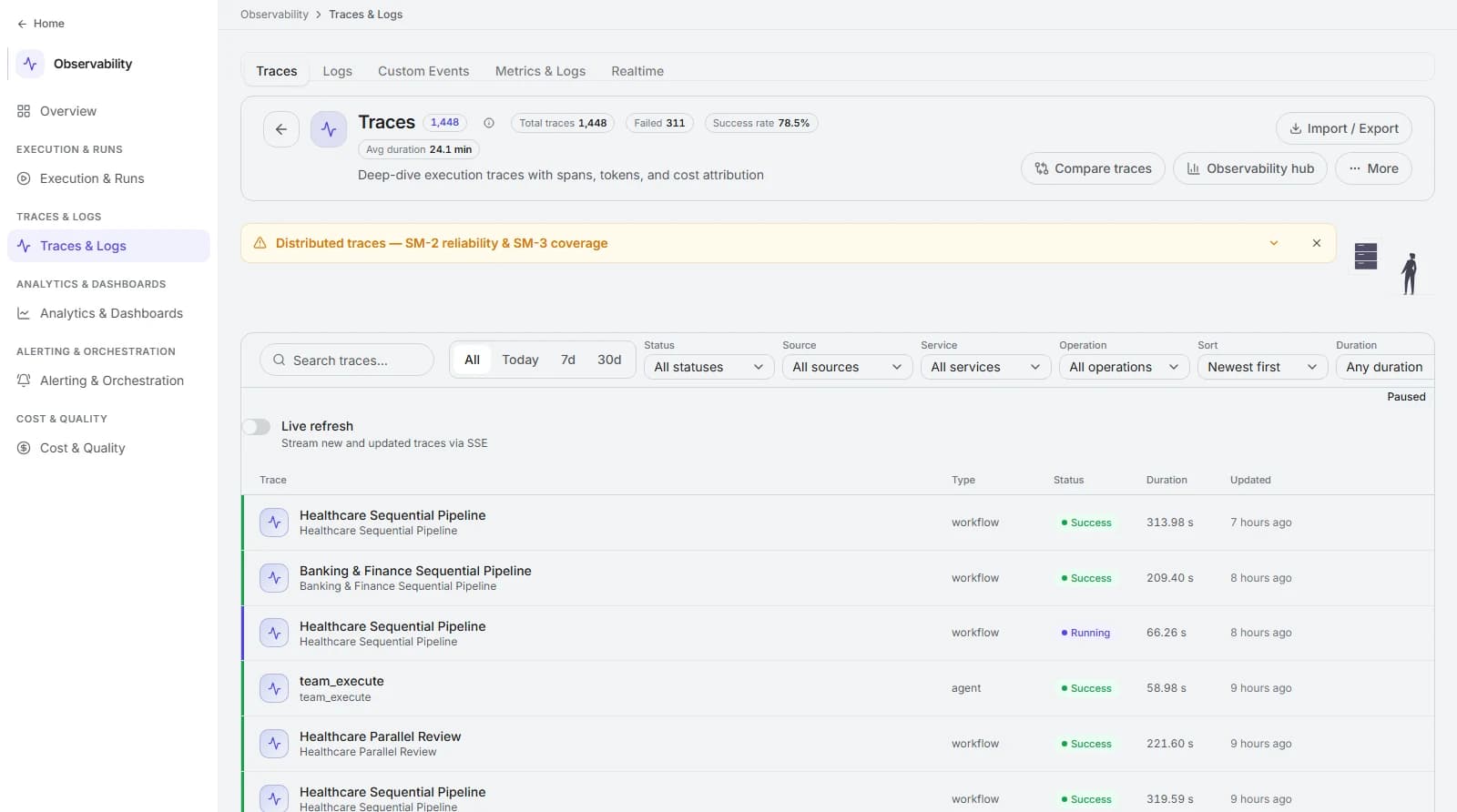
Every run, traced end to end.
1,448 traces with duration, status, and cost attribution - filter by status, source, service, and operation, or stream new runs live.
The return
How engineering value is calculated
Hours saved is easy to claim and easy to inflate. These definitions are deliberately conservative so the result holds up when a CFO reads it.
Engineering hours saved
(baseline time-to-answer − current) × answered questions
The primary lever. Baseline is sampled from your own teams before rollout, not taken from an industry benchmark.
Interrupt volume
expert-directed questions per engineer per week
The senior-engineer protection metric - the cost that never appears in a sprint report.
Time to first useful context
incident declared → responders have history and recent changes
Compresses the discovery phase of an incident, which is where most of the avoidable minutes sit.
Onboarding ramp
start date → first independent production change
Slow to move and worth reporting anyway, because it is the metric engineering leaders are actually judged on.
| Dimension | Before | With Bhogar |
|---|---|---|
| Understanding a service | Read the code, guess the intent, then confirm with whoever wrote it. | Read a cited answer that includes the decision record and the incident that shaped it. |
| Incident response | Twenty minutes assembling history before diagnosis begins. | Prior incidents, recent deploys, and runbook steps assembled as responders join. |
| Documentation debt | Nobody knows which missing doc costs the most. | Unanswerable questions are ranked by frequency and routed to owners. |
| New joiner ramp | Ramp speed depends on which teammate has time this week. | Self-service context, with humans reserved for judgement rather than lookup. |
FAQ
Frequently asked questions
Is our source code used to train models?
How is this different from an AI coding assistant?
What about stale documentation producing wrong answers?
Do private repositories stay private?
How do we prove hours saved rather than assert them?
Keep exploring
Operations
Take the waiting out of multi-step processes - the handoffs, the exceptions, and the checks that only a person could make until now.
Finance
Shorten the close by removing the reconciliation and evidence-gathering that fills the first ten days of every month.
IT & internal helpdesk
Resolve access, device, and software requests at the moment they are raised, instead of queueing them behind a service-desk backlog.
Start with the questions your seniors answer twice a week
Bring a list of recurring interrupt questions. We will show which are answerable from your existing sources today, and what the remaining gaps would take.