Solution · Operations
Operations
Rules-based automation already handles the clean path. What remains is judgement on unstructured input - and that is exactly the gap an AI platform closes, inside workflows your team still controls.
ROI lever
Cycle-time reduction
Operational processes are mostly queue time. Work sits waiting for someone to notice it, read an attachment, check a rule, and pass it on. Cycle time measures that end to end, which is why it is the honest operations lever: it improves only when the waiting actually disappears, not when individual steps look busier.
Reads from
- ERP & core records
- Documents & email
- Policies & SOPs
- Case history
The problem
The exceptions are the process
Every operations leader has automated the happy path. The cost sits in the cases that fall out of it: the non-standard document, the missing field, the supplier who replies in prose instead of a form.
Checked by hand today
- ERP & core system records
- Supplier & partner email
- Contracts & signed terms
- Scanned forms & PDFs
- Standard operating procedures
- Spreadsheet trackers
“Where is this case actually stuck right now, and what is it waiting for?”
Automation stops where the document starts
RPA and integrations move structured records reliably. The moment a step depends on reading a contract, an email thread, or a scanned form, the work returns to a human queue.
Handoffs create invisible queues
A process that takes four hours of effort routinely takes nine days elapsed. The difference is time spent waiting in inboxes, and it is rarely measured because no single team owns the whole path.
Exception handling depends on tenure
The people who know what to do with an unusual case learned it over years. When they are on leave, the queue grows; when they leave, the knowledge leaves with them.
How Bhogar helps
How Bhogar supports operations teams
Bhogar reads the unstructured input, applies your documented policy, and hands a decision back to a workflow that still enforces sequence, approvals, and audit.
Sources
- ERP & core records
- Documents & email
- Policies & SOPs
- Case history
Outcomes
- Extracted structured data
- Auto-completed case
- Triaged exception
- Approval request
Understanding unstructured input
Contracts, invoices, forms, and email threads are read and turned into the structured fields the next system needs, with the source passage retained for every extracted value.
How it works →Deterministic orchestration
Steps, retries, branches, and human checkpoints are defined as a workflow. The model contributes judgement at specific nodes; it does not decide the shape of the process.
How it works →Exception triage with reasoning
Fallouts are classified, matched to prior resolutions, and routed with a recommended action and the policy clause that supports it - so the queue arrives pre-diagnosed.
How it works →Approvals where the risk is
Thresholds decide what proceeds unattended and what waits for a person. Approvers see the proposed action, the evidence, and the rule that triggered the pause.
How it works →
All your data
What Bhogar connects for operations
Operations data is unusually mixed: clean records on one side, documents and correspondence on the other. Value comes from treating both as one working memory.
Core systems
ERP, WMS, order management, and scheduling records - the structured state a process moves through.
Inbound documents
Purchase orders, delivery notes, certificates, and scanned forms arriving in a dozen formats.
Correspondence
Supplier and partner email threads where the real status of an exception is usually explained.
Procedures & policy
SOPs, work instructions, and the tolerance thresholds that decide what counts as acceptable.
Case history
How previous exceptions of this type were resolved, and by whom, so precedent is retrievable.
Master data
Suppliers, sites, SKUs, and contract terms - the reference data that makes a decision correct.
Governance built in
- Every extracted value keeps a pointer to the source passage, so a downstream dispute is settled by evidence, not by re-keying.
- Value and risk thresholds decide autonomy per step, and those thresholds are configuration rather than prompt wording.
- Workflow runs are fully traced - inputs, decisions, tool calls, approvals - and retained for audit.
- Segregation of duties is preserved: an agent proposing an action cannot also be the approver of it.
The workflow
An exception, handled end to end
Modelled on a delivery or invoice mismatch, the most common operations fallout. The same pattern applies to onboarding a supplier, processing a claim, or clearing a compliance check.
A case falls out of the clean path
A mismatch, missing field, or non-standard document stops the automated flow and would normally land in a queue.
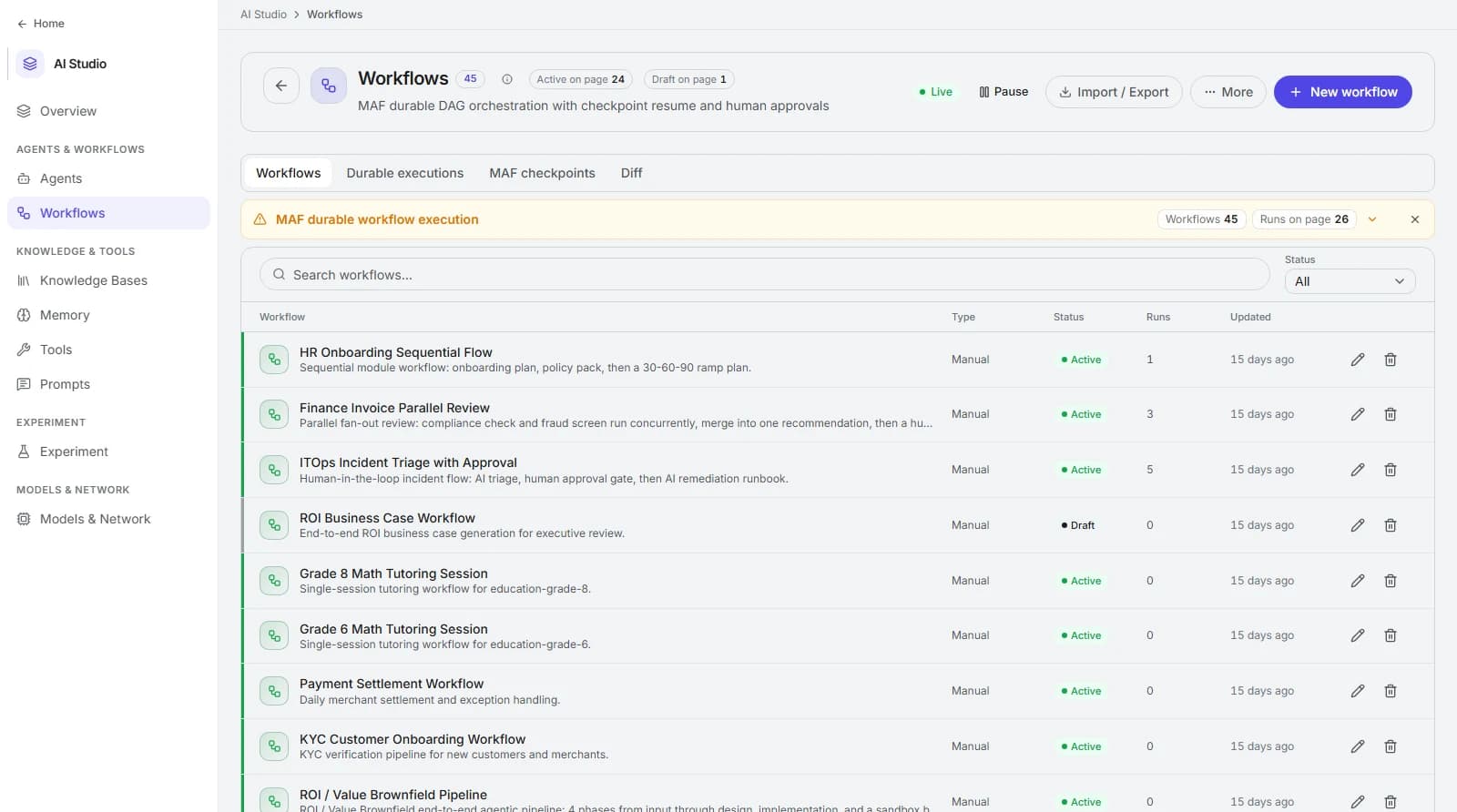
In the portal
Durable workflows with approvals built in.
Multi-step processes - onboarding, invoice review, incident triage, KYC - run as checkpointed DAGs with human approval gates.
The return
How operations value is calculated
Operations is the easiest department to measure honestly, because the timestamps already exist in your core systems. The work is agreeing which clock starts and stops.
Cycle time
median elapsed time from case created to case closed
The primary lever. Elapsed, not effort - it only improves when queue time genuinely disappears.
Straight-through rate
cases completed with no human touch ÷ total cases
Tracked per exception type, because a single blended number hides where the remaining cost actually is.
Touches per case
distinct human interactions ÷ closed cases
The handoff metric. Falls before cycle time does, and predicts where cycle time will move next.
Rework rate
cases reopened or corrected ÷ closed cases
The guardrail. Automation that produces downstream corrections is cost moved, not cost removed.
| Dimension | Before | With Bhogar |
|---|---|---|
| Non-standard document | Routed to a person to read, interpret, and re-key. | Read and structured automatically, with the source passage kept for verification. |
| Exception queue | Undifferentiated backlog worked in arrival order. | Classified, prioritised, and arriving with a recommended resolution. |
| Policy application | Depends on which experienced person picks up the case. | The same documented rule applied every time, with the clause cited. |
| Process visibility | Status is reconstructed from a spreadsheet and a few inboxes. | Every case traced end to end with elapsed time per step. |
FAQ
Frequently asked questions
Does this replace our RPA and integration platform?
How do you keep a language model out of decisions it should not make?
What happens when it reads a document wrong?
Can we prove what happened for an audit?
Where should a first operations workflow start?
Keep exploring
Finance
Shorten the close by removing the reconciliation and evidence-gathering that fills the first ten days of every month.
IT & internal helpdesk
Resolve access, device, and software requests at the moment they are raised, instead of queueing them behind a service-desk backlog.
HR & people
Get new starters productive sooner and let employees answer their own policy questions - without HR reading the handbook aloud.
Pick one exception type and measure it properly
We map a single process end to end, agree where the clock starts and stops, and show which steps Bhogar can take over inside your existing controls.