Platform
Knowledge & RAG
A model knows the internet. An AI platform knows your refund policy, this customer’s order history, last quarter’s incident write-up, and which of them is out of date. Knowledge & RAG is the part that turns your content into retrievable, permission-aware, citable memory.
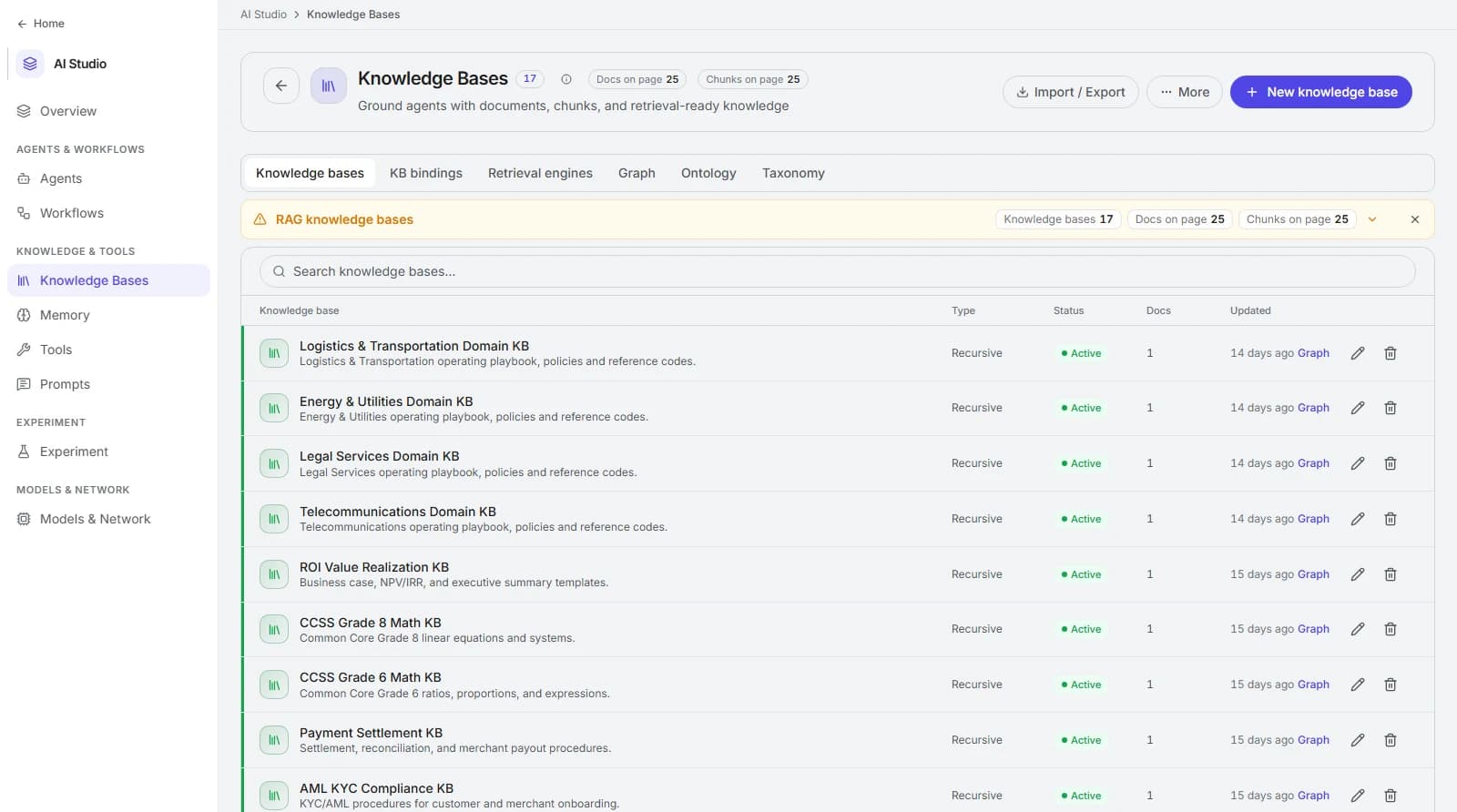
How it works
How documents become answers
You can start with defaults and get useful answers on day one, then tune chunking, ranking, and sync cadence where evaluations show it matters.
Connect the sources
Point a knowledge base at the systems that hold the truth and inherit their permission model.
Capabilities
Knowledge management capabilities
Production RAG is mostly unglamorous engineering: parsing, chunking, permissions, freshness, and evaluation. All of it is platform behaviour here.
Layout-aware ingestion
PDFs, office documents, HTML, spreadsheets, transcripts, and database rows are parsed with their structure intact - headings, tables, and lists survive the trip.
documents - records - threads
Chunking that keeps meaning
Structure-aware splitting with overlap and parent-document links, so a retrieved passage still carries the section it belongs to.
configurable size - overlap - parent linking
Embeddings in a safe store
Vectors are written to pgvector alongside tenant, workspace, and permission metadata - memory lives in the same safe data plane as your records.
pgvector - HNSW index
Hybrid retrieval
Dense vector search combined with keyword matching, so exact identifiers, product codes, and policy names are found alongside semantic matches.
vector + keyword - fusion ranking
Reranking for precision
A rerank pass reorders candidates before they reach the model, which raises answer quality more cheaply than enlarging the context window.
recall then precision
Permission-aware answers
Retrieval is filtered by the requesting user’s access. Two people can ask the same question and correctly receive different answers.
source ACL → role mapping
Freshness and incremental sync
Connectors re-index changed content rather than rebuilding everything, and answers can expose when their sources were last synced.
incremental indexing - last-synced state
Citations by default
Answers are composed from retrieved passages and carry links back to the source, so a reader can verify a claim in one click.
source attribution on every claim
Multiple knowledge bases
Scope memory by department, product, or customer, and grant agents only the bases their job requires instead of one undifferentiated index.
per-workspace knowledge bases
Ontology
Entity classes, properties, and relationships that guide LLM graph extraction.
Taxonomy
Hierarchical terms and document tags for routing and query filters.
Knowledge graph
Opt-in entity/relationship extract, hop query, and visualization in Postgres.
Engines
Vector, BM25, hybrid, and rerank bindings per knowledge base.
Design decisions
Design decisions
These are the choices that separate a demo from something a compliance team will sign off on.
- Why retrieval beats a bigger context window
- Pasting more text raises cost and latency and buries the relevant passage. Retrieval selects the few passages that matter, which is cheaper per answer, faster, and far easier to cite and audit.
- Why hybrid search, not vectors alone
- Pure vector search struggles with exact tokens - invoice numbers, SKUs, error codes, policy titles. Keyword matching covers that, and fusion ranking gives you both without asking users to phrase questions differently.
- Where freshness actually breaks
- Stale indexes cause quietly wrong answers, which erode trust faster than an outage. Incremental sync plus visible last-synced state means Bhogar can say how current its evidence is.
- Permissions are a retrieval concern
- Filtering after generation is too late - the model has already seen the content. Bhogar applies the permission filter during retrieval, so restricted passages never enter the prompt.
- Structured data belongs in memory too
- Documents alone give partial answers. Knowledge bases can draw on database and warehouse content, so Bhogar reasons over policy text and the live record it applies to.
- Evaluate retrieval separately from generation
- Most quality complaints are recall failures, not model failures. Grounding and citation-accuracy suites isolate retrieval quality, so tuning targets the real cause.
Design decisions
Design decisions
These are the choices that separate a demo from something a compliance team will sign off on.
Time spent hunting across wikis, drives, tickets, and threads collapses to one question.
Hours saved on lookup
baseline search time × answered queries
Grounded, cited answers instead of confident invention.
Answer accuracy
grounding and citation-accuracy evaluation scores
Questions resolved from memory without opening a ticket or interrupting an expert.
tasks deflected
self-served answer events vs escalations
New joiners reach useful output without a senior colleague as a search interface.
Onboarding ramp
query volume and resolution rate by tenure cohort
Retrieval keeps prompts small, so precision lowers spend as well as raising quality.
Cost per answer
tokens and model cost per answered query
Which sources are indexed, how fresh they are, and where the missing datas remain.
Knowledge coverage
indexed sources and last-sync status per knowledge base
FAQ
Frequently asked questions
Does our content get used to train models?
How does Bhogar handle conflicting documents?
What file types and sources are supported?
How large can a knowledge base get?
Do we need to re-index when a document changes?
Related capabilities
Explore the rest of the platform
Cognition
Model Gateway
One routing layer across providers with fallback, budgets, caching, and per-request cost attribution.
Reasoning
Agents
Autonomous agents that retrieve company context, call tools, and resolve work end to end.
Action
Workflows
Durable DAG execution for multi-step business processes, with branching, retries, and human approvals.
See Bhogar on your own data
Book a 45-minute working session. We connect one of your sources, build one agent, run one governed workflow, and review the trace together.