Solution · Sales & revenue
Sales & revenue
A connected Bhogar platform gives sellers the security answer, the pricing precedent, and the account history at the moment the buyer asks - and shows revenue leadership which of those moments changed the outcome.
ROI lever
Sales cycle time and revenue influence
Most deals do not stall on price. They stall on waiting - for a security questionnaire, a reference architecture, a pricing exception, or an answer that lives in another team. Cycle time measures that waiting directly. Revenue influence measures which of those interventions actually moved a deal forward, so enablement spend stops being justified by anecdote.
Reads from
- CRM & opportunities
- Contracts & pricing
- Calls & email
- Support & product truth
The problem
Cycle time is where revenue quietly leaks
A seller who can answer in the meeting keeps momentum. A seller who has to route the question through three internal teams gives the buyer a week to lose interest, and gives a competitor a week to work.
Checked by hand today
- CRM opportunities & notes
- Past RFP & security responses
- Call recordings & email threads
- Pricing approvals & contracts
- Product roadmap & docs
- Support & escalation history
“What did we promise this account before, and what is blocking the deal now?”
Every questionnaire is answered again
Security reviews, procurement forms, and RFPs repeat the same 200 questions with different wording. Your best answers already exist in past responses - they are just not retrievable when the deadline is 48 hours away.
Account knowledge lives in people, not the CRM
What was promised in the last renewal, which integration blocked the pilot, what support has been dealing with - that context sits in inboxes, calls, and tickets. A rep joining an account inherits fields, not understanding.
Enablement cannot prove it worked
Content, battlecards, and coaching are funded on faith. Without attribution linking an intervention to stage movement, the first budget cut lands on the thing nobody can measure.
How Bhogar helps
How Bhogar supports sales & revenue teams
Bhogar reads the systems that hold the truth about an account - CRM, contracts, conversations, support history, product reality - and answers in the seller’s workflow rather than in another tab they must remember to open.
Sources
- CRM & opportunities
- Contracts & pricing
- Calls & email
- Support & product truth
Outcomes
- Drafted RFP response
- Pre-call account brief
- Updated CRM record
- Approval with rationale
Questionnaire and RFP drafting
Past approved responses, security documentation, and current product truth are retrieved per question, so a response starts at a reviewable draft instead of a blank grid.
How it works →Account briefs that reflect reality
Open support issues, delivery commitments, usage signals, and prior contract terms are summarised into a brief a rep can read before a call - and trust in front of the buyer.
How it works →Agents that keep the deal moving
Follow-ups drafted from the call, CRM fields updated from the transcript, approvals raised with the justification attached. The administrative tail of selling becomes an execution, not a to-do.
How it works →Claims that stay inside policy
Roadmap language, performance claims, and discount language run through guardrails, so what a fast answer gains it does not give back in legal exposure.
How it works →
All your data
What Bhogar connects for revenue teams
Revenue answers are cross-functional by nature. The value comes from joining commercial systems to the operational systems that reveal whether a promise is safe to make.
CRM & pipeline
Opportunities, stages, close plans, contacts, and the notes reps actually write after calls.
Historical responses
Completed RFPs, security questionnaires, and procurement forms with the answers your reviewers already approved.
Contracts & pricing
Signed terms, discount precedent, approval thresholds, and the commitments those documents created.
Conversations
Call transcripts and email threads, so the last three months of an account are searchable rather than remembered.
Product & roadmap
Documentation, release notes, and roadmap status - what is shipped, what is planned, what should not be promised.
Delivery & support
Open tickets, escalations, and health signals that decide whether an expansion conversation is credible this quarter.
Governance built in
- Deal data stays inside CRM permissions - territory and team boundaries are enforced by retrieval, not by convention.
- Roadmap and performance claims are constrained to approved language, with unapproved statements flagged before they are sent.
- Discount and contract exceptions route to the existing approval chain with the supporting rationale attached.
- Every generated response keeps its sources, so legal and security review a draft with provenance rather than a guess.
The workflow
From inbound question to closed-won, with less waiting
This is the security-review path, the pattern that most often decides an enterprise cycle. The same shape applies to RFPs, pricing exceptions, and renewal preparation.
A blocking request arrives
A security questionnaire, architecture question, or procurement form lands mid-cycle with a short deadline attached.
In the portal
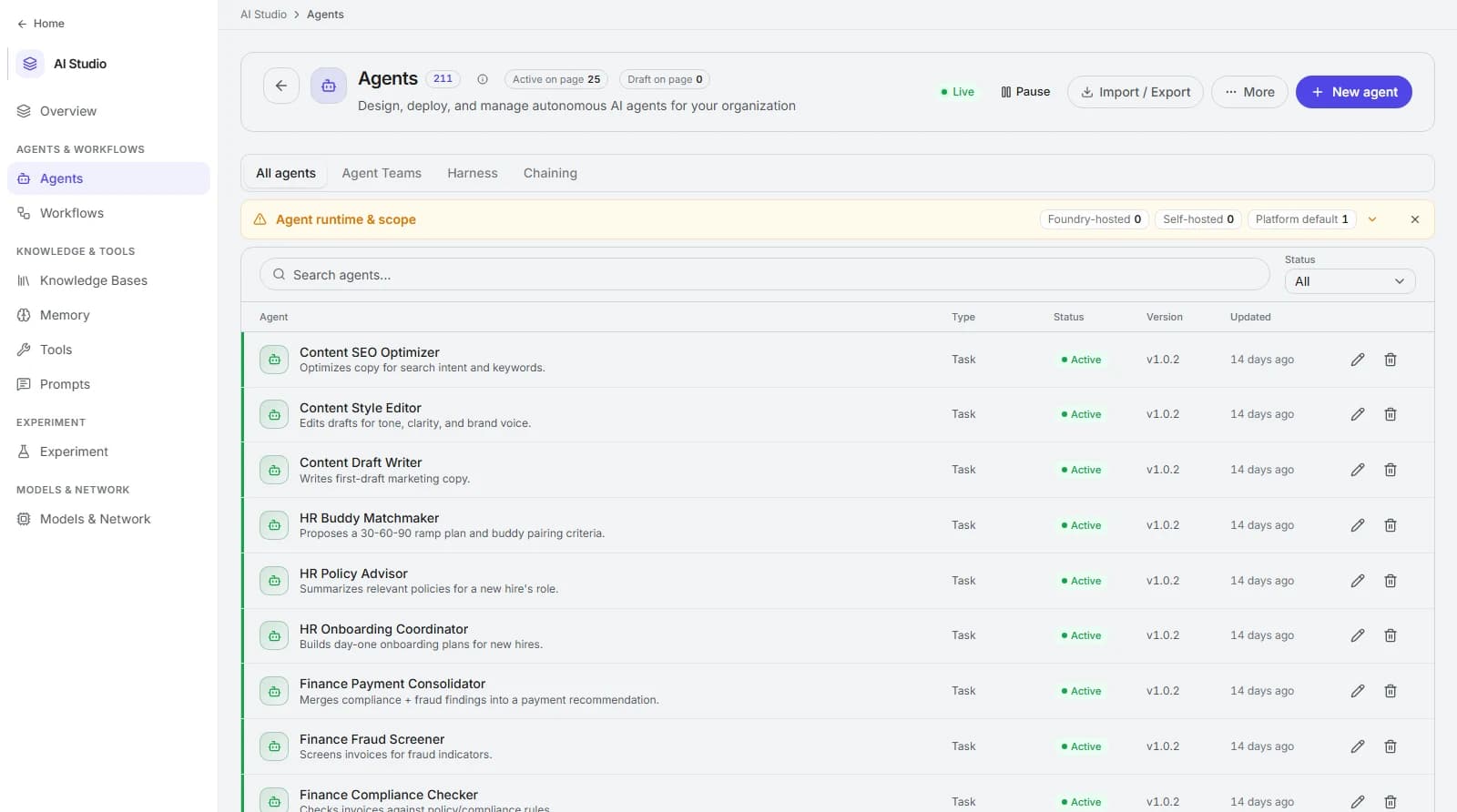
Task agents with a defined job, versioned.
211 agents across content, HR, and finance - each with a type, status, and version, grouped into teams and chains.
The return
How revenue value is calculated
Sales ROI claims collapse under scrutiny when they rest on self-reported time savings. These metrics come from CRM timestamps and platform traces you already have.
Sales cycle time
median days from qualified stage to closed-won
The primary lever. Segment by deal size and motion - enterprise cycles and self-serve cycles respond very differently.
Revenue influence
pipeline value of opportunities that advanced within N days of an assisted action
Influence, deliberately, not credit. It shows where Bhogar participated without pretending it closed the deal.
Response turnaround
buyer request received → approved response returned
The clearest early signal, because questionnaire and RFP turnaround is measured in days before and hours after.
Selling time recovered
hours saved on drafting and CRM admin × loaded seller cost
Reported as capacity created, not as headcount removed - the honest framing for a quota-carrying team.
| Dimension | Before | With Bhogar |
|---|---|---|
| Security questionnaire | A week of chasing four internal owners for answers given before. | A cited draft the same day, with only genuinely new questions routed to owners. |
| Pre-call preparation | Ten minutes of CRM skimming and hoping nothing has broken since last quarter. | A brief covering commitments, open issues, usage, and prior terms. |
| CRM hygiene | Updated on Friday from memory, if at all. | Fields and next steps drafted from the call, confirmed by the rep in seconds. |
| Enablement reporting | Content usage counts with no link to pipeline. | Influenced pipeline and cycle-time deltas tied to specific assisted actions. |
FAQ
Frequently asked questions
Will it invent product capabilities to win a deal?
Do reps have to change how they work?
How do you avoid overstating attribution?
Can it respect territory and deal-team boundaries?
What does the first 90 days usually target?
Keep exploring
Engineering
Give engineers back the hours lost to archaeology - finding why a system behaves this way, who owns it, and what already broke before.
Operations
Take the waiting out of multi-step processes - the handoffs, the exceptions, and the checks that only a person could make until now.
Finance
Shorten the close by removing the reconciliation and evidence-gathering that fills the first ten days of every month.
Measure your own cycle time before you change it
We start from your CRM timestamps and a set of completed questionnaires, then show where days are actually lost and what the first workflow would compress.