Platform
Data & Integrations
Most AI disappointment traces back to coverage: the answer lived in a system nobody connected. Bhogar treats all your data as a product requirement - every source connected, safe, permission-aware, attributable, and current.
How it works
Connecting a source
Coverage is a programme, not a one-off import. The sequence below is how teams widen it without losing control of access.
Inventory the sources
List what a process actually depends on - including the spreadsheet and the message thread nobody documents.
Capabilities
Integration capabilities
Connection is the easy part. Keeping access correct, state current, and provenance intact is the work that decides whether Bhogar can be trusted.
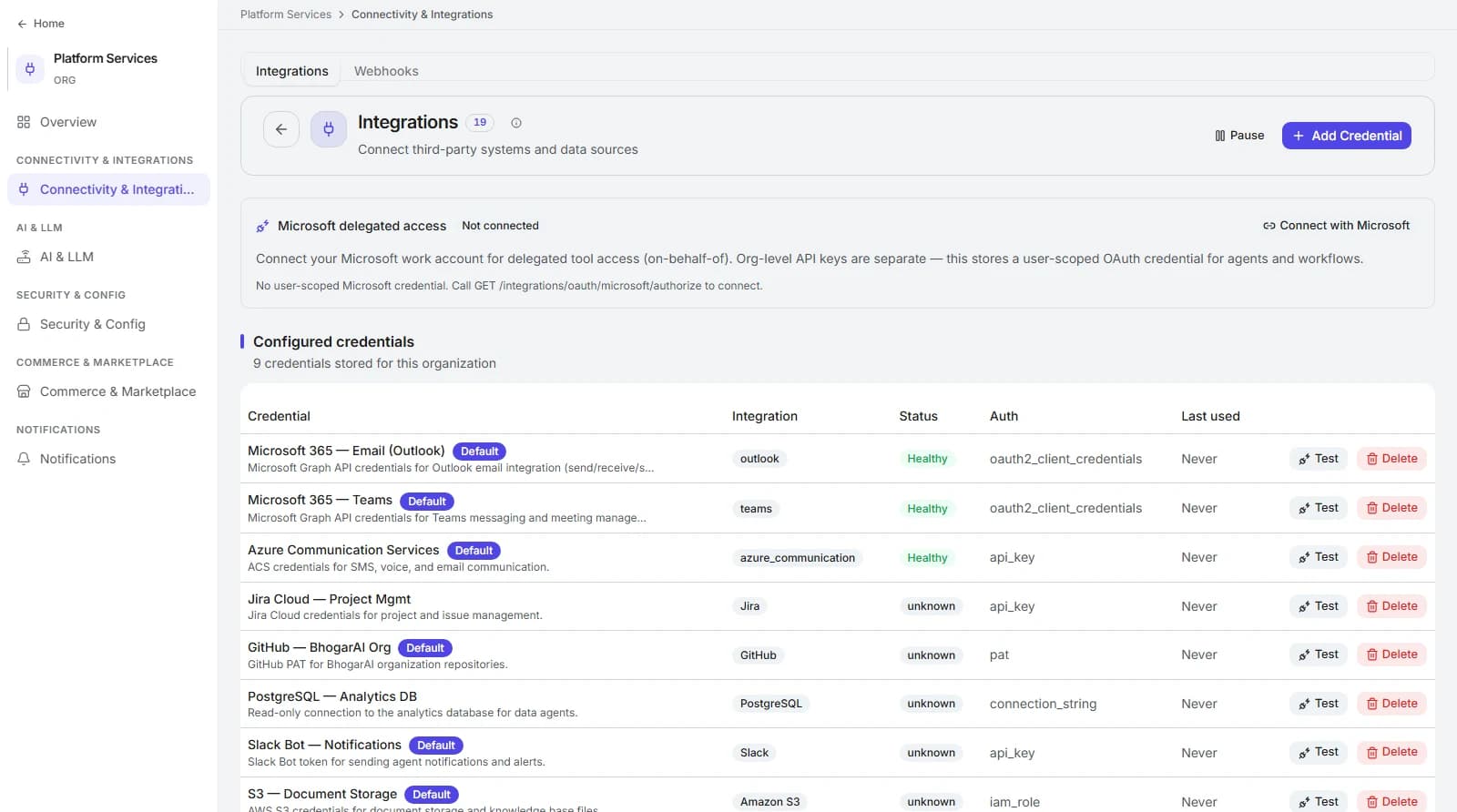
Connector library
Ready-made connectors for the systems most companies run - collaboration suites, service desks, CRM, code hosts, storage, messaging, and data warehouses.
Portal - Data → Integrations
Databases and warehouses
Query relational and analytical stores directly, so Bhogar reasons over live records instead of a stale export.
Postgres - SQL - warehouse queries
Custom tools and APIs
Register any internal service as a safe tool with its own auth, schema, and permissions - including MCP-compatible tools.
tool registry - MCP - REST
Event-driven updates
Webhooks push changes as they happen, so time-sensitive processes react in seconds rather than waiting for the next sync window.
inbound + outbound webhooks
Sync you can reason about
Per-source cadence, incremental change detection, and visible last-sync state - including which runs failed and why.
scheduled - incremental - retry
Permission mapping
Source-side access rules are translated into Bhogar roles and workspaces at connect time, so downstream retrieval inherits them.
source ACL → RBAC
Lineage and attribution
Every indexed item records where it came from, which sync produced it, and which version it represents - the basis for explaining any answer.
source - sync run - version
Tenant isolation
companies and workspaces separate data at the platform level, so connected sources never leak across business units or customers.
org + workspace scoping
Residency and network control
Enterprise deployments support private networking and your own cloud account, for sources that cannot leave a boundary.
private networking - BYOC options
Design decisions
Design decisions
The positions below explain the trade-offs behind the connectivity model - and why they matter to answer quality.
- Coverage is the ceiling on intelligence
- A platform that can only see the wiki gives wiki-shaped answers. Every additional connected source removes a missing data and raises the number of questions the platform can answer without a human intermediary.
- Copy less, query more
- Some content belongs in the index; live records belong behind a query. Bhogar supports both so you are not forced to duplicate a database to make it usable - which also shrinks your data-sprawl surface.
- Permissions travel with the data
- Mapping source ACLs at connect time means access decisions do not have to be re-invented per agent or per workflow. One permission model covers retrieval, tool calls, and value reporting.
- Freshness is a first-class signal
- Answers carry how recently their sources were synced, and sync failures surface as operational events rather than silent staleness. Trust survives when Bhogar can say “this is 40 minutes old”.
- Lineage makes answers defensible
- Every claim resolves to a source, a version, and a sync run. That is what lets an auditor, a regulator, or a sceptical executive verify an answer instead of taking it on faith.
- Custom systems are not second-class
- The tool registry treats your internal services like any other source: schema, auth, permissions, rate limits, and tracing. Bespoke systems are usually where the differentiated value lives.
Design decisions
Design decisions
The positions below explain the trade-offs behind the connectivity model - and why they matter to answer quality.
Share of real questions Bhogar can resolve without a human lookup.
Answerable question rate
resolved vs unresolved query classification
Assembling context from four systems becomes a single request.
Hours saved on data gathering
baseline gathering time × completed runs
One source of truth stops teams re-answering the same question in parallel.
Duplicate-work reduction
repeat-question volume per topic
Managed connectors instead of bespoke point-to-point scripts to keep alive.
Integration maintenance cost
connector count vs custom pipelines retired
Decisions made on current state rather than last month’s export.
Data freshness
last-sync age distribution per source
Each connected source compounds what every existing agent can do.
Coverage growth
connected sources and indexed volume over time
FAQ
Frequently asked questions
Do we have to move our data into Bhogar?
What if a source we need has no connector?
How are source permissions respected?
How is one customer’s or business unit’s data kept separate?
How do we know a sync is healthy?
Related capabilities
Explore the rest of the platform
Memory
Knowledge & RAG
Ingestion, chunking, embeddings, hybrid retrieval, freshness, and citations - Bhogar’s working memory.
Cognition
Model Gateway
One routing layer across providers with fallback, budgets, caching, and per-request cost attribution.
Reasoning
Agents
Autonomous agents that retrieve company context, call tools, and resolve work end to end.
See Bhogar on your own data
Book a 45-minute working session. We connect one of your sources, build one agent, run one governed workflow, and review the trace together.