Industry · Industries - Financial services
Financial services
Your policy library, core systems, case files, and customer history live apart, so every KYC refresh, complaint, and dispute is reassembled by hand. BhogarAI connects them into one safe platform that answers with citations, drafts the case pack, and leaves an audit trail behind every action.

ROI lever
cost to serve per case
Banks, insurers, and asset managers already know what a case costs: analyst minutes plus rework plus the risk of getting it wrong. Bhogar attacks all three at once - it assembles the case pack, cites the controlling policy, and records what was retrieved and why, so the quality-control pass gets shorter instead of longer.
Reads from
- Core banking and ledgers
- CRM and correspondence
- Policy and procedure library
- KYC and screening case files
The problem
The answer exists. It is just spread across eight systems and one senior analyst.
Regulated work is not slow because people are slow. It is slow because the evidence needed to make a defensible decision has to be gathered from systems that were never designed to talk to each other - and then re-gathered when the reviewer asks a question.
Checked by hand today
- Core banking / policy admin
- CRM and customer correspondence
- KYC, screening, and case management
- Procedure manuals and circulars
- Complaints and dispute logs
- Document and records archive
““What is our current position on this customer, under the policy version in force on the date of the transaction?””
Policy drifts away from practice
Procedure manuals, regulatory circulars, and internal control standards are versioned in different places. Front-line teams answer from memory or from a colleague, and the second line finds the gap months later during testing.
Case packs are rebuilt by hand every time
A single KYC refresh or complaint response pulls from core banking, the CRM, document storage, the sanctions and screening tool, and prior correspondence. Analysts spend more time collecting evidence than judging it.
Nothing carries its provenance
When an answer arrives as a chat message or a spreadsheet, the reasoning behind it disappears. Supervisors re-derive it, auditors sample it, and remediation costs more than the original work did.
How Bhogar helps
How Bhogar is deployed in financial services
Retrieval is grounded in your approved corpus with permissions applied at query time, so a relationship manager and a compliance analyst asking the same question get answers scoped to what each is allowed to see.
Sources
- Core banking and ledgers
- CRM and correspondence
- Policy and procedure library
- KYC and screening case files
Outcomes
- Drafted case packs
- Cited policy answers
- Complaint responses for review
- Audit-ready run records
Policy-grounded answers with citations
Every response points to the controlling clause, its version, and its effective date. Staff stop guessing which manual is current, and reviewers can check the source in one click.
How it works →Case assembly across core systems
Agents pull the customer record, prior correspondence, screening results, and supporting documents into one structured pack, flagging what is missing rather than quietly proceeding without it.
How it works →Controls enforced before the model, not after
Entitlements, restricted-data rules, and prohibited-action policies are evaluated on the request path. A prompt cannot reach data the requester has no right to see.
How it works →Evidence that survives review
Every run records the inputs, retrieved sources, model, tools called, and approver. Sampling for quality control moves from reconstruction to inspection.
How it works →
All your data
Connect the regulated record, not a copy of it.
Sources stay where they are safe. Bhogar indexes what it is permitted to index, respects retention and residency rules, and re-reads the system of record for anything that changes by the minute.
Core banking and policy administration
Balances, transactions, product terms, and account status read at answer time rather than cached into a prompt.
Procedure and control library
Operating manuals, internal control standards, regulatory circulars, and the change log that tells Bhogar which version applied when.
Customer files and correspondence
CRM notes, letters, secure-message threads, and call summaries that establish what the customer was previously told.
Case management and screening
KYC and onboarding cases, sanctions and PEP screening outcomes, alert dispositions, and analyst rationale.
Complaints, disputes, and remediation
Complaint logs, root-cause codes, redress decisions, and prior positions taken on comparable facts.
Contracts and legal documents
Master agreements, terms, schedules, and side letters that govern what can actually be offered to a given client.
Governance built in
- Row- and document-level entitlements enforced at retrieval - the model never sees what the requester cannot see.
- Configurable redaction for account numbers, national identifiers, and other sensitive fields before text reaches a provider.
- Regional deployment and data-residency controls, including private model endpoints where cross-border transfer is restricted.
- Immutable run records with inputs, sources, tool calls, and approvals for supervisory review and internal audit.
- Human approval gates on any action that changes a customer record, commits the firm, or communicates externally.
The workflow
A KYC refresh, end to end.
The same pattern applies to complaint handling, dispute investigation, and regulatory change assessment - different inputs, same safe path from trigger to reviewed outcome.
Periodic review falls due
A scheduled event or a risk-rating change in the case management system starts the workflow with the customer identifier and review type.
In the portal
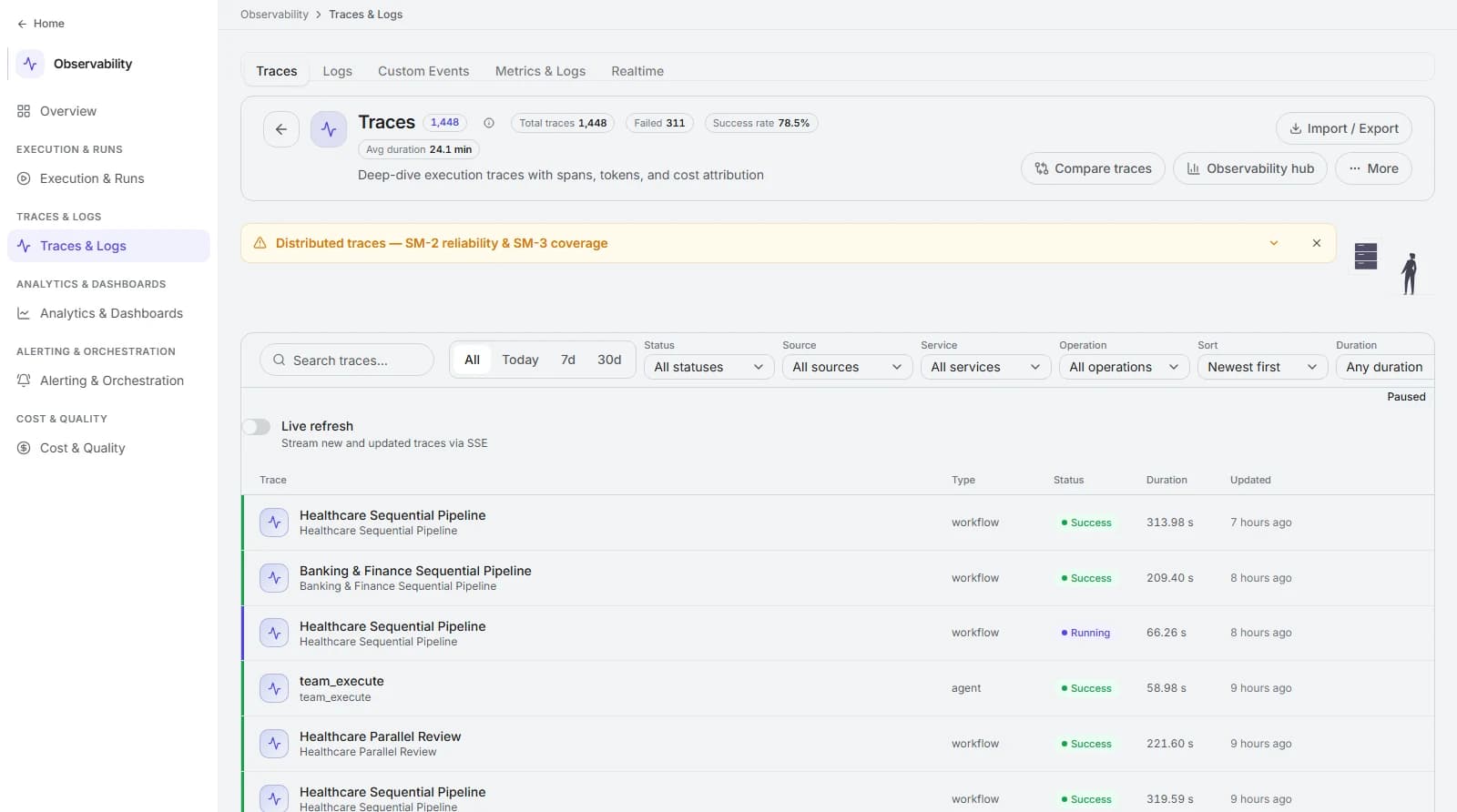
Every run, traced end to end.
1,448 traces with duration, status, and cost attribution - filter by status, source, service, and operation, or stream new runs live.
The return
Measured the way your COO already measures operations.
Set a baseline from your current case data before go-live. Every metric below is calculated from your own runs in Observe - these are definitions, not claims.
cost to serve per case
(analyst minutes × loaded rate) + platform cost ÷ cases completed
The number your operations committee already reviews. Platform cost is attributed per run, so the comparison is honest rather than flattering.
Case cycle time
median hours from case open to approved outcome
Assembly is usually the bottleneck, not judgment. Cycle time moves first, and it is the metric regulators ask about for backlogs.
Rework rate
cases returned by QC or second line ÷ cases submitted
A case pack that carries its citations should fail review less often. Rising rework is an early warning that retrieval scope is wrong.
Evidence completeness
runs with full source and approval trail ÷ total runs
Audit readiness expressed as a percentage rather than an assurance. Anything below target is a queryable list, not a surprise.
| Dimension | Before | With Bhogar |
|---|---|---|
| Finding the controlling policy | Staff search a document library, ask a colleague, or rely on the version they remember. | The answer cites the clause, its version, and its effective date, scoped to the requester’s entitlements. |
| Building a case pack | An analyst opens six systems and copies evidence into a template. | The pack arrives drafted with citations and an explicit list of missing evidence. |
| Supervisory review | The reviewer reconstructs how the analyst reached the conclusion. | The reviewer inspects a recorded trail of inputs, sources, and approvals. |
| Reporting to the risk committee | Manual sampling and a spreadsheet assembled at quarter end. | Cost, cycle time, rework, and completeness reported continuously from run data. |
FAQ
Frequently asked questions
Can we keep data inside our own region and infrastructure?
How do you stop an agent from taking an action it should not take?
What evidence do we have if a regulator or internal audit asks how an answer was produced?
Does this make automated decisions about customers?
Keep exploring
Healthcare
Give administrative hours back to clinical and access teams - prior authorisation, payer policy, denials, and patient access answered from your approved sources.
Retail
Answer order, returns, and product questions from live systems instead of a stale help centre - and hold cost per contact flat through peak.
Manufacturing
Put maintenance history, OEM manuals, SOPs, and quality records in one place so technicians diagnose faster and downtime stops repeating.
Bring your hardest case type to the walkthrough.
We will map it against your policy library, your entitlements model, and your evidence requirements - and show you the run record a reviewer would receive.