Industry · Industries - Manufacturing
Manufacturing
Your maintenance history, OEM documentation, SOPs, and quality records already contain the answer to most faults. BhogarAI connects them into one platform that technicians can ask on the floor, with the traceability your quality system requires.

ROI lever
Unplanned downtime hours
Every hour a line is down has a known cost per hour, which makes manufacturing one of the easiest sectors to build an honest business case in. Bhogar attacks the diagnosis-and-parts phase of mean time to repair, where technicians are searching rather than fixing.
Reads from
- CMMS and asset history
- OEM manuals and bulletins
- SOPs and work instructions
- Quality, NCR, and CAPA records
The problem
Experience walks out the door and the same fault comes back.
Plants run on institutional knowledge that is unevenly distributed across shifts and increasingly retiring. Meanwhile the documented knowledge exists - it is just unsearchable in the ten minutes a stopped line allows.
Checked by hand today
- CMMS work orders and asset history
- OEM manuals and service bulletins
- SOPs and work instructions
- Quality, NCR, and CAPA records
- Engineering change notices and BOMs
- Shift handover and operator logs
““Has this asset thrown this fault before, what fixed it, and did the engineering change last quarter alter the procedure?””
Diagnosis is a search problem before it is a skill problem
A technician facing an unfamiliar fault needs the OEM bulletin, the last three work orders on that asset, and the deviation history. Finding those takes longer than the repair, and the line is down for all of it.
Quality records and maintenance records never meet
Non-conformances, CAPAs, and engineering changes live apart from the CMMS. Recurring root causes stay invisible because nobody can join the two datasets by asset and date.
Handovers lose the detail that mattered
What the previous shift tried, ruled out, and suspected is compressed into a few lines in a log. The next crew repeats the first two hours of diagnosis.
How Bhogar helps
How Bhogar is deployed in manufacturing
Retrieval spans structured maintenance records and unstructured documentation at once, so a symptom description returns the relevant history, the current procedure, and the parts actually required.
Sources
- CMMS and asset history
- OEM manuals and bulletins
- SOPs and work instructions
- Quality, NCR, and CAPA records
Outcomes
- Guided fault diagnosis
- Parts and procedure ready
- Drafted closure notes
- Recurring-cause analysis
Symptom-to-history retrieval
A plain description of what the machine is doing returns comparable past work orders on that asset and asset class, what was actually replaced, and how long each repair took.
How it works →Current procedure, current revision
Work instructions and OEM bulletins are returned at their controlled revision, with superseded versions marked, so a technician is never working from a procedure that an engineering change replaced.
How it works →Parts and readiness in one answer
The agent resolves the part numbers the procedure requires against stores availability and lead time, so the trip to the crib happens once.
How it works →Drafted quality and maintenance records
Work order closure notes, 8D sections, and CAPA drafts are generated from what actually happened during the job, then reviewed and signed by the responsible engineer.
How it works →
All your data
Read the plant’s systems. Never write to the ones that move machinery.
Bhogar connects to maintenance, quality, engineering, and documentation systems. Control systems are read-only at most, and no agent is permitted to issue a command to operational technology.
Maintenance management
Work orders, asset registers, preventive schedules, failure codes, labour hours, and parts consumed per job.
OEM and technical documentation
Equipment manuals, service bulletins, wiring and hydraulic schematics, torque and tolerance specifications.
Procedures and work instructions
Controlled SOPs, standard work, lockout and safety procedures, with revision status and approval history.
Quality records
Non-conformances, deviations, 8D reports, CAPA records, inspection results, and supplier quality history.
Engineering and configuration
Bills of material, engineering change notices, as-built configuration, and the effectivity dates that decide which applies.
Production context
Summarised historian and MES data - run rates, downtime events, and reason codes - correlated with maintenance activity.
Governance built in
- Read-only integration with operational technology; agents cannot issue commands to control systems or change setpoints.
- Export-controlled and customer-confidential drawings segregated by entitlement so cross-programme access is not possible.
- Revision-aware retrieval that marks superseded procedures rather than returning them as current.
- Quality-record drafts always routed for signature by the responsible engineer, preserving your approval chain.
- Site-level data residency for plants operating under differing national requirements.
The workflow
A line stop, from alarm to signed closure.
The same pattern supports planned maintenance preparation, supplier quality investigations, and engineering change impact assessment.
The line stops
A downtime event with asset, fault code, and time is raised from the maintenance system or by the operator on shift.
In the portal
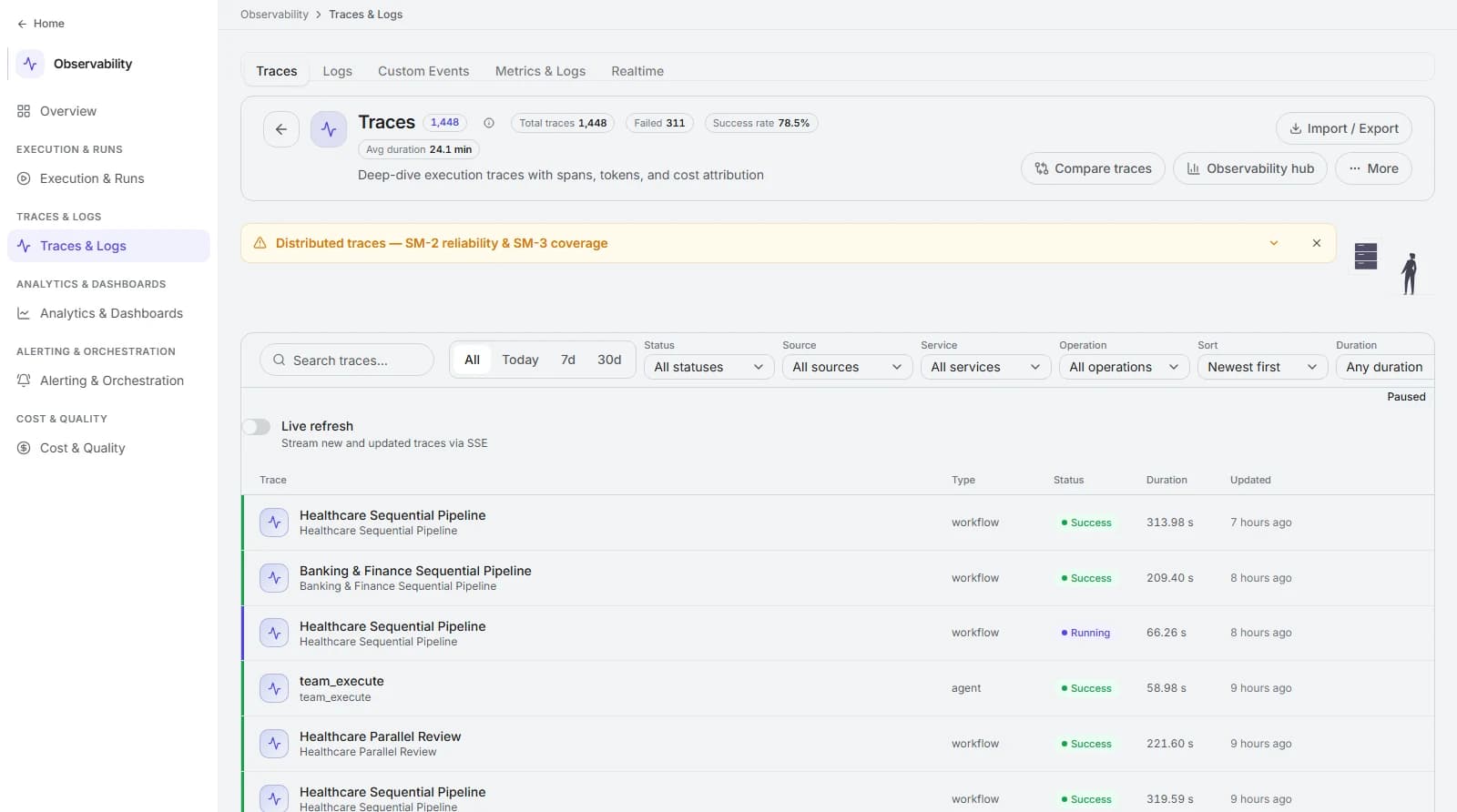
Every run, traced end to end.
1,448 traces with duration, status, and cost attribution - filter by status, source, service, and operation, or stream new runs live.
The return
Downtime has a price per hour. Start there.
Use your existing cost-per-downtime-hour figure and your current maintenance baseline. Every metric is computed from your systems and your runs.
Unplanned downtime hours
Σ downtime hours × cost per hour by line
The headline number. Attribute only the diagnosis and parts-identification portion to the platform - inflated attribution destroys credibility with operations.
Mean time to repair
total repair hours ÷ number of repairs
Split diagnosis time from wrench time. Bhogar moves diagnosis; if wrench time moves, something else changed.
First-time-fix rate
jobs closed without a repeat visit ÷ total jobs
Correct parts and the current procedure on the first trip. A leading indicator that shows up before downtime totals do.
CAPA cycle time
median days from non-conformance raised to CAPA closed
Drafting and evidence gathering dominate this cycle, which is why it responds quickly even though the approvals stay human.
| Dimension | Before | With Bhogar |
|---|---|---|
| Diagnosing an unfamiliar fault | Search the CMMS, find a manual, call the experienced technician on days. | One query returns comparable history, the current procedure, and applicable bulletins. |
| Getting the right parts | Two trips to stores and a part that turns out to be superseded. | Part numbers resolved against the current BOM and stock before the technician leaves the line. |
| Closing the work order | Terse notes written at end of shift, of limited use to the next crew. | A drafted record produced from the job and reviewed while the detail is fresh. |
| Finding recurring causes | Quality and maintenance data analysed separately, if at all. | Repeat patterns surfaced across both, by asset class and by change event. |
FAQ
Frequently asked questions
Can this touch our PLCs or SCADA?
Our manuals are scanned PDFs and drawings. Does that work?
How do we stop a superseded procedure being returned as current?
Will it work across sites with different equipment and languages?
Keep exploring
Technology
Deflect support at the docs, answer security questionnaires from evidence you already have, and keep support cost from tracking headcount as you scale.
Public sector
Answer citizen enquiries and support case workers from statute, policy, and guidance - with transparency, accessibility, and a human decision-maker on every determination.
Financial services
safe answers and case work across core banking, KYC files, complaints, and the policy library - with an evidence trail supervisors and auditors accept.
Pick one line and one cost-per-hour figure.
We will scope the corpus for that asset class, connect the maintenance history, and build the downtime business case with your reliability team.