Industry · Industries - Healthcare
Healthcare
Payer policies change, prior authorisation rules differ by plan, and denial reasons are buried in correspondence. BhogarAI connects your administrative sources into one safe platform that drafts the packet, cites the rule, and routes every decision to a named human.

ROI lever
Administrative hours returned
The scarce resource in healthcare is not compute, it is clinician and access-team time. Bhogar targets the administrative layer around care - prior authorisation packets, payer policy lookups, denial appeals, scheduling and coverage questions - where the work is high volume, rule-driven, and almost entirely document retrieval.
Reads from
- Payer policies and criteria
- Departmental protocols
- Scheduling and access data
- Denial and appeal history
The problem
Administrative work expands to fill every hour that is not direct care.
Access teams, revenue cycle staff, and clinicians all spend part of their day answering questions whose answers already exist in a document somebody else maintains. The cost shows up as delayed care, avoidable denials, and burnout.
Checked by hand today
- Payer coverage policies and portals
- Prior authorisation criteria by plan
- Scheduling and access systems
- Denial and appeal correspondence
- Departmental protocols and SOPs
- Formularies and referral guidance
““Under this patient’s plan, what exactly is required for this procedure to be authorised - and do we have it?””
Payer rules are a moving target
Coverage policies, prior authorisation criteria, and formularies vary by plan and change without warning. Staff work from PDFs, portals, and institutional memory, so submissions go out against criteria that changed last quarter.
Denials are re-litigated from scratch
An appeal needs the original submission, the clinical documentation, the specific policy criterion cited, and the language that worked last time. Assembling that is a half-day of work per case.
Access questions escalate to clinical staff
Patients and referrers ask about coverage, preparation, timing, and eligibility. When the front line cannot answer confidently, the question lands on a nurse or a physician who is between appointments.
How Bhogar helps
How Bhogar is deployed in healthcare
The design constraint here is deliberate: Bhogar assembles, cites, and drafts. Clinical and coverage determinations stay with the qualified human who signs them, and the platform records who that was.
Sources
- Payer policies and criteria
- Departmental protocols
- Scheduling and access data
- Denial and appeal history
Outcomes
- Drafted authorisation packets
- Cited coverage answers
- Appeal letters for review
- Access answers for the front line
Payer policy retrieval by plan and date
Answers name the plan, the criterion, and the version in effect, so staff submit against the rules that actually apply instead of the ones they last memorised.
How it works →Prior authorisation packet drafting
Agents assemble the required elements against the plan checklist, surface the documentation that is missing, and prepare the submission for review rather than sending it.
How it works →Minimum-necessary access by role
Retrieval is scoped by role and purpose. A scheduler, a revenue-cycle analyst, and a clinician each see only what their role justifies, enforced before the request reaches a model.
How it works →A record of who decided what
Each run captures the sources used, the draft produced, the edits made, and the person who approved the outcome - the trail your compliance team needs when a case is reviewed.
How it works →
All your data
Administrative sources first - and PHI handled on your terms.
Most of the value sits in documents that are not patient records at all. Where protected health information is genuinely required, access is scoped, redaction is configurable, and processing stays inside the boundary your privacy office has approved.
Payer coverage and authorisation criteria
Medical policy documents, plan-specific prior authorisation requirements, formularies, and the effective dates that decide which version applies.
Departmental protocols and SOPs
Preparation instructions, referral pathways, documentation standards, and escalation rules maintained by each service line.
Revenue cycle correspondence
Denial letters, appeal outcomes, remittance remarks, and the phrasing that has previously satisfied a given payer.
Access and scheduling context
Availability, location, preparation requirements, and referral status used to answer patient and referrer questions.
Credentialing and onboarding material
Privileging requirements, orientation content, and role-specific policy packs used to bring new staff up to speed.
Clinical documentation, where authorised
Read-only, purpose-scoped access to the specific elements a submission requires - never a bulk copy of the record.
Governance built in
- Deployment inside your own cloud workspace separation and region, with a business associate agreement in place before any protected health information is processed.
- Minimum-necessary retrieval: role and purpose scoping applied at query time, not filtered out of the answer afterwards.
- Configurable de-identification and redaction of identifiers before text is sent to any model provider, including private endpoints where required.
- Full audit logging of access, retrieval, drafts, edits, and approvals, retained under your existing retention schedule.
- Human decision gates on anything that affects care, coverage, or patient communication - the platform drafts, a qualified person decides.
The workflow
Prior authorisation, from referral to submitted packet.
The same shape covers denial appeals, coverage questions from the front line, and onboarding new access staff onto plan-specific rules.
An order needs authorisation
A referral or order enters the queue with the procedure, the plan, and the ordering clinician attached.
In the portal
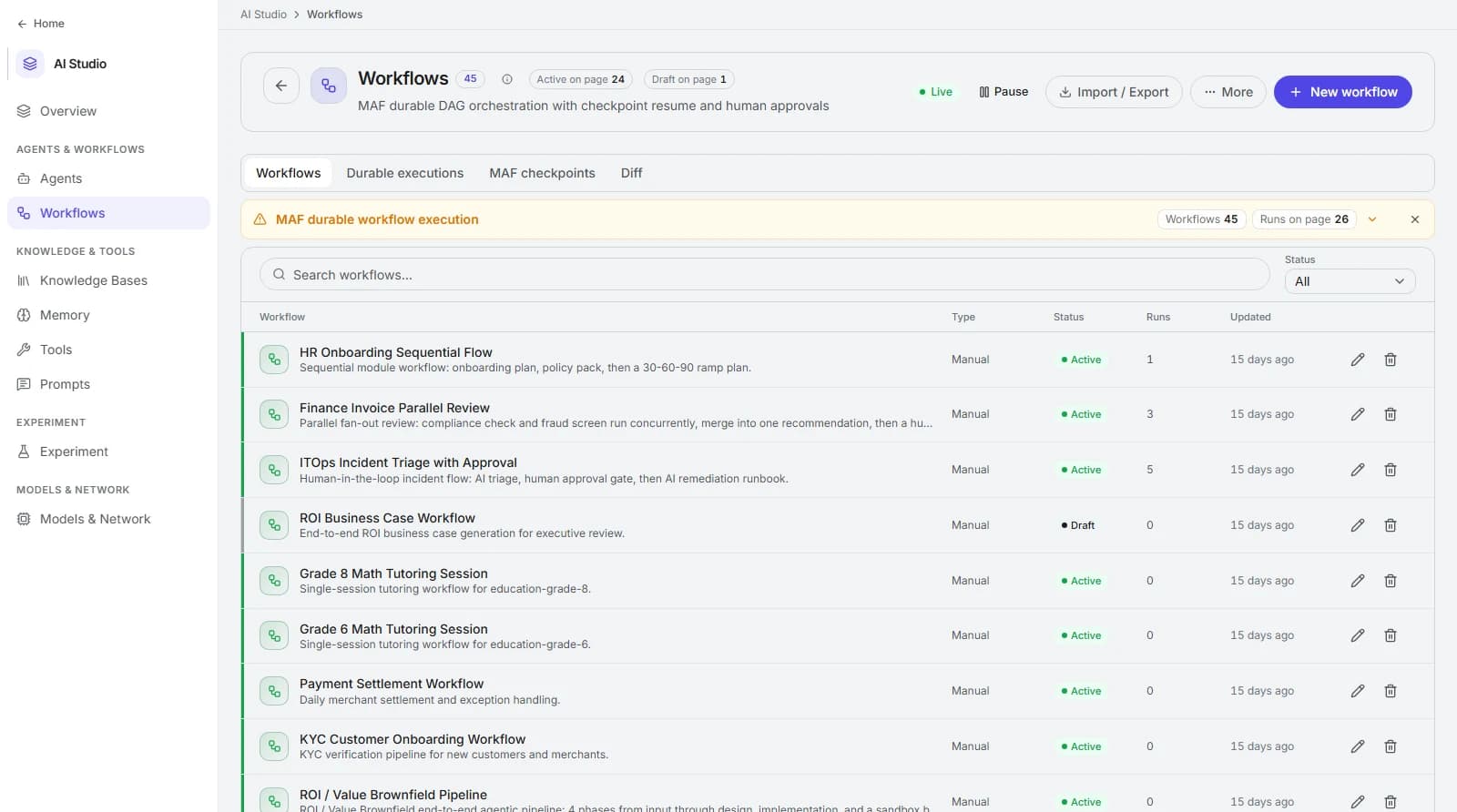
Durable workflows with approvals built in.
Multi-step processes - onboarding, invoice review, incident triage, KYC - run as checkpointed DAGs with human approval gates.
The return
Hours returned, denials avoided, waits shortened.
Baseline from your current queues before go-live. Every figure below is computed from your own runs and your own finance assumptions.
Administrative hours returned
(baseline minutes − post minutes) × volume ÷ 60
Split by role. Hours returned to a clinician and hours returned to a scheduler have very different values, and your CFO will want them separated.
Prior authorisation turnaround
median hours from order received to packet submitted
The metric patients feel. Most of the delay is assembly and chasing missing documentation, which is exactly what Bhogar removes.
First-pass approval rate
authorisations approved without appeal ÷ submissions
Submitting against the current criterion with complete evidence is the cheapest way to reduce denial volume.
Denial rework cost
appeal hours × loaded rate + write-offs avoided
Appeals are expensive twice: staff time and delayed revenue. Track both against the pre-deployment baseline.
| Dimension | Before | With Bhogar |
|---|---|---|
| Checking payer criteria | Staff open a payer portal or a saved PDF and hope it is current. | The answer names the plan, the criterion, and the effective date, with the source attached. |
| Preparing a submission | Documentation is gathered manually and gaps surface after a rejection. | The packet is drafted against the checklist and missing evidence is listed up front. |
| Front-line access questions | Uncertain answers escalate to nursing or physician time. | The front line answers with a cited source and escalates only genuine clinical questions. |
| Compliance review | Access and rationale are reconstructed from memory and email. | Access, sources, edits, and approvals are logged against each run. |
FAQ
Frequently asked questions
Will BhogarAI sign a business associate agreement?
Does the platform make clinical or coverage determinations?
How is protected health information kept out of model providers?
How long before an access team sees a difference?
Keep exploring
Retail
Answer order, returns, and product questions from live systems instead of a stale help centre - and hold cost per contact flat through peak.
Manufacturing
Put maintenance history, OEM manuals, SOPs, and quality records in one place so technicians diagnose faster and downtime stops repeating.
Technology
Deflect support at the docs, answer security questionnaires from evidence you already have, and keep support cost from tracking headcount as you scale.
Start with one queue, not the whole hospital.
Pick your highest-volume authorisation or denial workflow and we will scope the corpus, the access model, and the turnaround baseline with your team.