Industry · Industries - Retail & e-commerce
Retail & e-commerce
“Where is my order” is not a knowledge question - it is a data question with a policy attached. BhogarAI connects your order, fulfilment, catalogue, and policy systems so customers and agents get the specific answer, and peak season stops being a hiring problem.

ROI lever
Contacts per 1,000 orders
Retail support cost scales with order volume unless something breaks the link. Contacts per 1,000 orders is the ratio that decides whether growth is profitable, and it moves when customers can get an accurate, order-specific answer without waiting for an agent.
Reads from
- Order management system
- Fulfilment and carrier events
- Product catalogue and specs
- Returns and promotion policy
The problem
Your help centre cannot see the order.
Most retail contacts are about one specific order, one specific item, or one specific promotion. Generic content deflects almost none of them, so volume lands on agents and cost per contact rises exactly when order volume does.
Checked by hand today
- Order management system
- Warehouse and 3PL tracking
- Product catalogue and PDP content
- Returns and warranty policy
- Promotions and pricing rules
- Contact-centre history
““Where is order 84‑21993, and can this customer still return the second item under the promotion they used?””
Status lives in systems the customer cannot reach
Order management, the warehouse, and the carrier each hold part of the truth. The customer sees a tracking page that has not updated in two days and opens a ticket that an agent resolves by checking three tabs.
Policy is interpreted differently by every agent
Returns windows, condition rules, promotional exclusions, and goodwill limits are documented somewhere, but under handle-time pressure agents apply the version they remember. Margin leaks through inconsistency.
Peak multiplies everything
Seasonal hiring, training, and quality dip together. The team that is least familiar with your policies is handling the highest volume in the highest-stakes weeks of the year.
How Bhogar helps
How Bhogar is deployed in retail & e-commerce
Live systems are read at answer time so status is never stale, while policy comes from your safe corpus so the ruling is consistent whether the customer asks at 2pm or 2am.
Sources
- Order management system
- Fulfilment and carrier events
- Product catalogue and specs
- Returns and promotion policy
Outcomes
- Resolved order enquiries
- Returns processed to policy
- Accurate product answers
- Escalations with full context
Live order and fulfilment lookup
Order status, shipment events, and exception codes are read from the system of record on each request, then explained in plain language with the next step and a realistic date.
How it works →Consistent policy application
Returns eligibility, promotional exclusions, and warranty terms are resolved against the versioned policy corpus, so the same facts produce the same answer every time.
How it works →Catalogue-grounded product answers
Fit, compatibility, materials, and care questions are answered from your own catalogue and specification data, with an explicit “not stated” rather than an invented claim.
How it works →Action with a spend limit
Reships, refunds, and goodwill credits run as permissioned tools inside configured thresholds. Anything above the limit is routed to a person with the case already assembled.
How it works →
All your data
Connect commerce systems, keep payment data out.
Bhogar needs order context, not card data. Payment identifiers are excluded from retrieval scope by design so your cardholder-data environment is not widened by adding an assistant.
Order management and commerce platform
Order lines, status, payment state as a flag rather than an instrument, addresses, and modification history.
Fulfilment, warehouse, and carrier
Pick and pack progress, shipment events, exception codes, and delivery estimates from your 3PL or carrier feeds.
Product catalogue and content
Specifications, variants, compatibility, care instructions, and the approved marketing claims for each item.
Policy library
Returns and exchange rules, warranty terms, promotional conditions, price-match rules, and goodwill thresholds.
Customer and loyalty context
Purchase history, tier, prior contacts, and open cases, so the answer accounts for what the customer was already told.
Supplier and inventory signals
Stock positions, inbound purchase orders, and lead times used to give an honest restock or substitution answer.
Governance built in
- Payment card data excluded from retrieval scope so the assistant does not extend your PCI DSS boundary.
- Refund, reship, and credit tools bounded by configurable value thresholds with escalation above the limit.
- Product claims restricted to approved catalogue content, with an explicit “not stated in our data” response instead of a guess.
- Personal data handled under your existing consumer privacy programme, with deletion and export requests honoured at the source system.
- Every automated resolution logged with the policy clause applied, so disputes and chargebacks have an evidence trail.
The workflow
A delivery exception, resolved without an agent.
The same path handles returns eligibility, promotion disputes, and product suitability - read the systems, apply the policy, act within limits, escalate with context.
Asks about a late order
The question arrives in chat, email, or the help centre, authenticated against the account so the order is known rather than requested.
In the portal
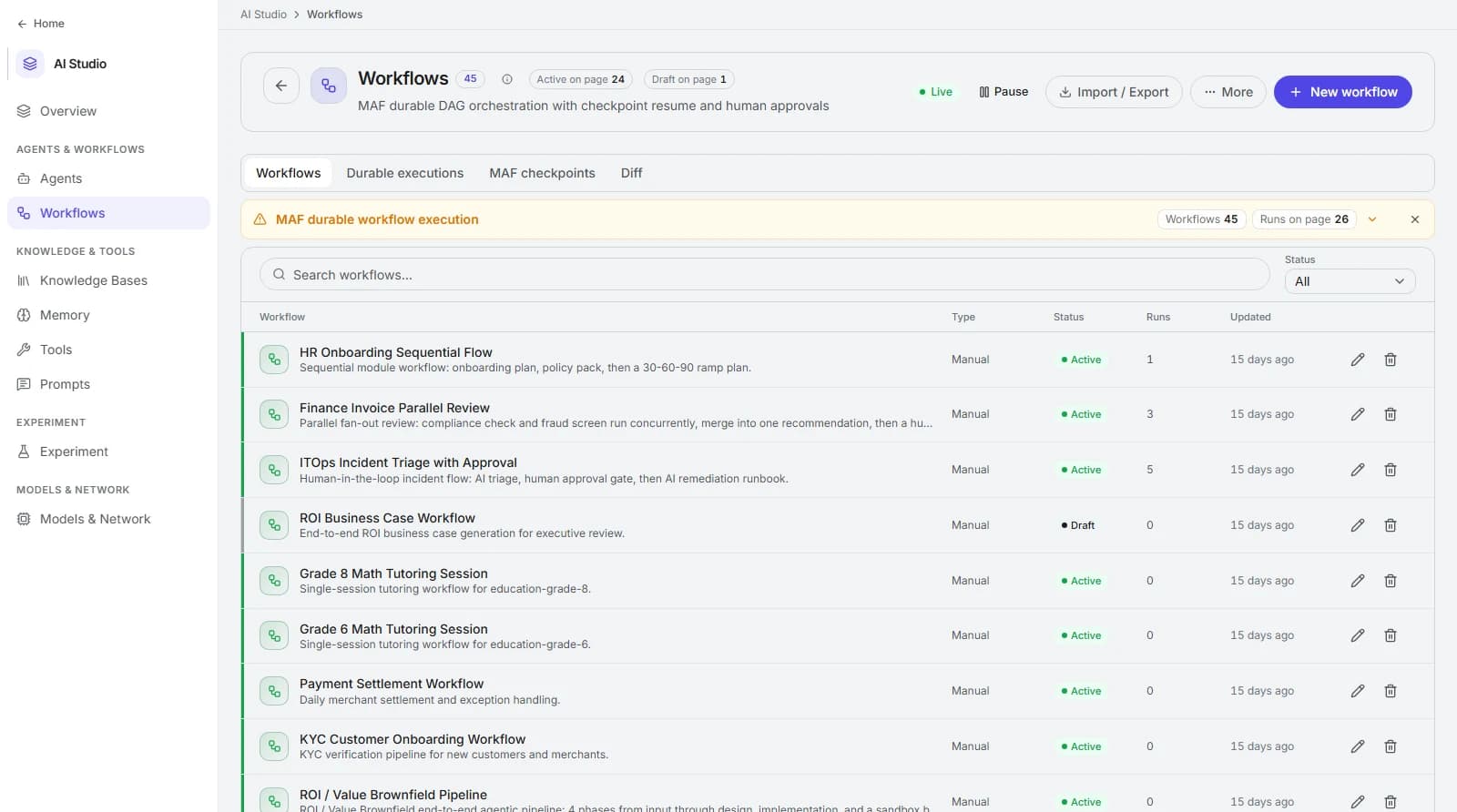
Durable workflows with approvals built in.
Multi-step processes - onboarding, invoice review, incident triage, KYC - run as checkpointed DAGs with human approval gates.
The return
The support-to-order ratio is the whole game.
Baseline contacts per 1,000 orders and cost per contact from your current season, then compare like for like. These are calculations, not projections.
Contacts per 1,000 orders
support contacts ÷ (orders ÷ 1,000)
Normalises for growth. If this falls while orders rise, support has stopped being a linear cost of scale.
tasks deflected
sessions resolved without agent handoff ÷ total sessions
Count only genuinely resolved sessions. Sessions the customer abandoned are not deflection and should not be reported as such.
Cost per contact
(agent minutes × loaded rate) + platform cost ÷ contacts
Include platform cost per run. Peak season is where the gap between automated and staffed cost is largest.
Refund and remedy cycle time
median hours from request to resolved remedy
Faster remedies reduce repeat contacts and chargebacks, which is a second-order saving worth attributing.
| Dimension | Before | With Bhogar |
|---|---|---|
| Order status enquiry | A tracking link, then a ticket, then an agent checking three systems. | One combined timeline with the exception named and the next step given. |
| Returns decision | Agent judgment under handle-time pressure, applied inconsistently. | The versioned policy applied identically, with the clause recorded. |
| Peak staffing | Seasonal hiring and training against a volume forecast. | Automated resolution absorbs routine volume; staff handle exceptions. |
| Product questions | Answers vary by agent and sometimes exceed what the catalogue supports. | Answers are grounded in approved catalogue content or explicitly declined. |
FAQ
Frequently asked questions
How do you stop the assistant inventing product claims?
Does connecting order data widen our PCI scope?
Can it issue refunds and reships on its own?
What happens during peak when volume triples?
Keep exploring
Manufacturing
Put maintenance history, OEM manuals, SOPs, and quality records in one place so technicians diagnose faster and downtime stops repeating.
Technology
Deflect support at the docs, answer security questionnaires from evidence you already have, and keep support cost from tracking headcount as you scale.
Public sector
Answer citizen enquiries and support case workers from statute, policy, and guidance - with transparency, accessibility, and a human decision-maker on every determination.
Bring last peak’s contact data.
We will map your top contact drivers to connected systems and show you which ones resolve end to end, which need policy work, and what each is worth.