Industry · Industries - Technology & SaaS
Technology & SaaS
Docs, changelog, tickets, incidents, and engineering issues all hold part of the answer your customer needs. BhogarAI connects them into one platform that resolves support at the first touch and turns security reviews from a fire drill into a retrieval task.

ROI lever
Support cost as a share of ARR
Software companies are measured on efficiency, and support plus solutions engineering is one of the few cost lines that grows with customers rather than with revenue. Deflection at the documentation layer and faster security-review turnaround attack both the cost line and the sales cycle.
Reads from
- Docs, API reference, changelog
- Support tickets and history
- Engineering issues and runbooks
- Security policies and prior answers
The problem
Every answer already exists - in a different repository.
Growth stage software companies have exceptional documentation and terrible findability. The result is a support queue full of answered questions and a solutions team writing the same security response for the fourth time this quarter.
Checked by hand today
- Product docs and API reference
- Changelog and release notes
- Support tickets and macros
- Engineering issues and PRs
- Incident postmortems and runbooks
- Security policies and past RFP answers
““Does the current release still behave this way, and what did we tell this customer about it last time?””
Support answers questions the docs already cover
Customers cannot find the page, or the page is right but the changelog contradicts it. Tier-1 volume stays high while the content that would resolve it sits unread.
Security reviews block deals
Each questionnaire asks the same forty questions in a different order. Answers live in policy documents, past responses, and the heads of two people who are also on call.
Incident context is scattered at the worst moment
During an incident the relevant runbook, the last similar postmortem, and the customers affected are in three systems, and the person who knows is already on the bridge.
How Bhogar helps
How Bhogar is deployed in technology & saas
Retrieval spans public documentation and internal systems with permissions applied, so a customer-facing assistant and an internal engineering assistant share the same platform but never the same answer scope.
Sources
- Docs, API reference, changelog
- Support tickets and history
- Engineering issues and runbooks
- Security policies and prior answers
Outcomes
- Deflected support contacts
- Drafted ticket responses
- Security questionnaires drafted
- Incident context assembled
Version-aware product answers
Responses are grounded in the docs and changelog for the release the customer is actually on, and say so, instead of describing behaviour that shipped two versions later.
How it works →Ticket resolution with account context
The agent reads the account’s plan, prior tickets, and known issues before answering, so the response accounts for what has already been said and escalates genuinely new problems.
How it works →Security questionnaire drafting
Answers are assembled from your policy set and previously approved responses, with each answer citing its source so the reviewer approves rather than rewrites.
How it works →Public and internal scopes, one platform
Customer-facing and internal assistants run on the same safe layer with different retrieval scopes and guardrails, so internal notes cannot leak into a customer reply.
How it works →
All your data
Connect the whole product record, then scope it per audience.
The same corpus serves customers, support, and engineering - what differs is the retrieval scope and the guardrail policy attached to each surface.
Product documentation and API reference
Guides, reference, code samples, and deprecation notices, indexed with the version they describe.
Release and change history
Changelog entries, migration guides, feature flags, and rollout status per environment or plan.
Support history
Ticket threads, resolutions, macros, and the known-issue register - including what a specific account was previously told.
Engineering systems
Issues, pull requests, architecture decision records, and internal runbooks, restricted to internal audiences.
Incident record
Postmortems, status history, customer impact records, and the mitigations that worked in comparable incidents.
Trust and compliance material
Security policies, sub-processor lists, architecture descriptions, and previously approved questionnaire responses.
Governance built in
- Separate retrieval scopes for public, customer, and internal surfaces so internal engineering context cannot reach a customer reply.
- Per-tenant isolation for anything derived from customer data, with configurable residency for regional obligations.
- Secret and credential detection on ingestion and on the response path, so tokens pasted into tickets are not re-emitted.
- Approved-answer requirements for trust and compliance responses - drafts always route to a named owner before they leave.
- Full traceability of which document version produced which customer-facing answer, for support quality review.
The workflow
A support contact, resolved or escalated properly.
The same platform runs the security questionnaire workflow and the incident assist workflow - different scopes, different guardrails, one safe platform.
Asks in the product or the docs
The question arrives in an authenticated surface, so plan, version, and account history are known before retrieval starts.
In the portal
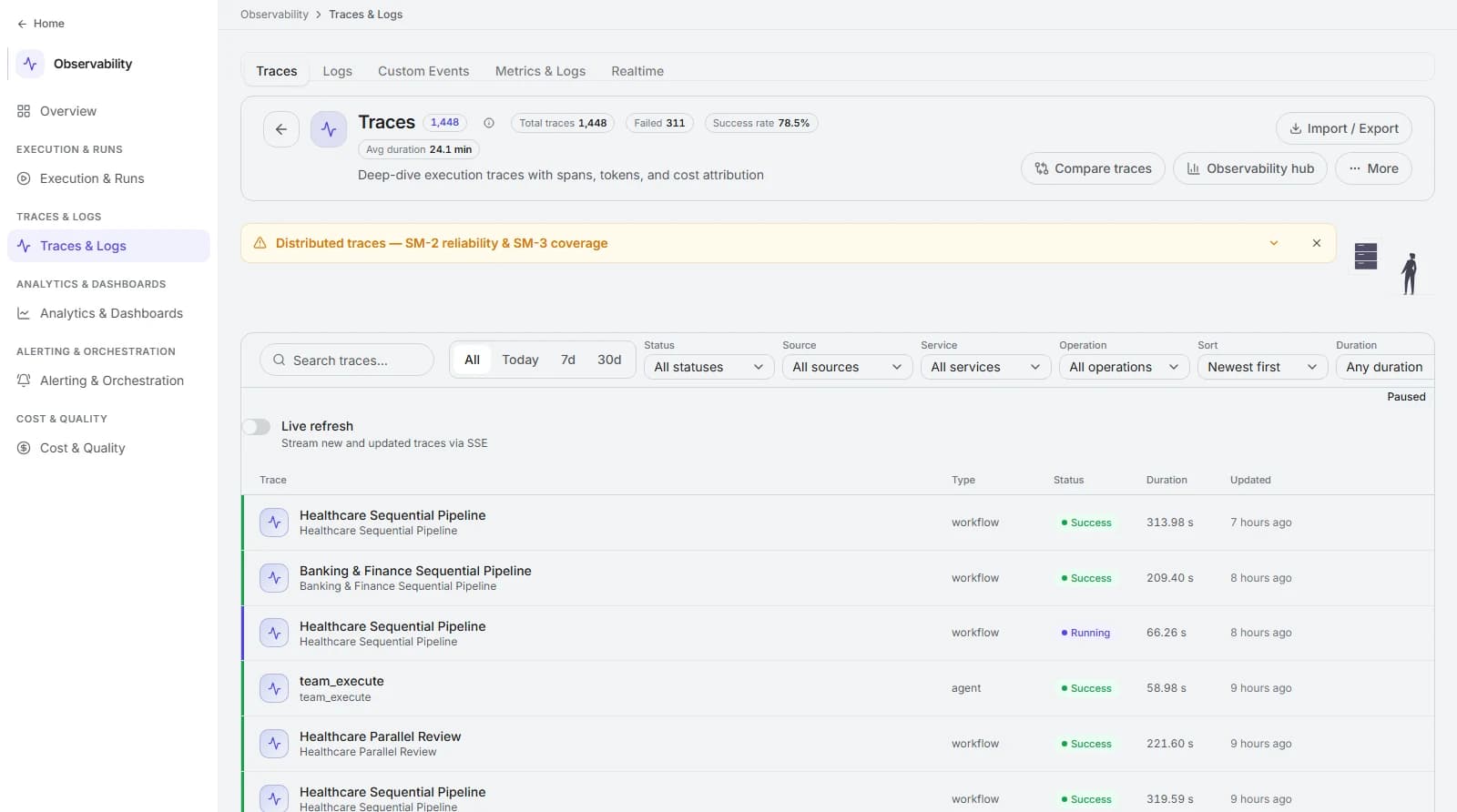
Every run, traced end to end.
1,448 traces with duration, status, and cost attribution - filter by status, source, service, and operation, or stream new runs live.
The return
Efficiency metrics your board already tracks.
Baseline from your current ticket and questionnaire data. Everything below is computed from your own runs against that baseline.
tasks deflected
sessions resolved without a ticket ÷ total assisted sessions
Only count sessions where the customer confirmed resolution or did not open a ticket within the window. Anything looser is marketing, not measurement.
Cost per resolved ticket
(agent minutes × loaded rate) + platform cost ÷ resolved tickets
Compare automated and assisted paths separately. Blending them hides which one is actually improving.
Security review turnaround
median hours from questionnaire received to answers approved
A sales-cycle metric as much as a cost metric. Shortening it moves revenue timing, not just effort.
Support cost as a share of ARR
fully loaded support cost ÷ ARR
The efficiency ratio that matters at board level. Track it quarterly rather than monthly so seasonality does not mislead.
| Dimension | Before | With Bhogar |
|---|---|---|
| Tier-1 product questions | Customers open tickets for answers the documentation already contains. | Version-aware answers with citations resolve the question in the product. |
| Escalations | A one-line handoff and a support engineer starting from zero. | A structured escalation with version, reproduction detail, and sources already checked. |
| Security questionnaires | Two senior people rewriting answers they have written before. | A cited draft from approved material, reviewed and approved by an owner. |
| Documentation gaps | Discovered from ticket trends months later. | Surfaced weekly as the questions that retrieved nothing useful. |
FAQ
Frequently asked questions
How do we keep internal engineering context out of customer answers?
Our docs are already good. What does this add?
Can we run this for our own customers under our brand?
What stops a provider outage from taking support down?
Keep exploring
Public sector
Answer citizen enquiries and support case workers from statute, policy, and guidance - with transparency, accessibility, and a human decision-maker on every determination.
Financial services
safe answers and case work across core banking, KYC files, complaints, and the policy library - with an evidence trail supervisors and auditors accept.
Healthcare
Give administrative hours back to clinical and access teams - prior authorisation, payer policy, denials, and patient access answered from your approved sources.
Bring one quarter of ticket data.
We will show which contact drivers your existing content can already resolve, which need new content, and what deflection is realistically worth at your volume.