Industry · Industries - Public sector
Public sector
Citizens ask the same questions across phone, web, and counter, and get different answers depending on who picks up. BhogarAI connects your legislation, policy manuals, and guidance into one safe platform that answers with citations, supports case workers, and never makes the determination itself.

ROI lever
Cost per enquiry and backlog days
Public bodies are judged on service levels and stewardship of public money at the same time. Bhogar reduces the cost of answering routine enquiries and shortens case backlogs, while keeping every determination with an accountable officer - which is the only way the saving survives scrutiny.
Reads from
- Legislation and guidance
- Local policy and instructions
- Case management records
- Published forms and content
The problem
The rules are public. Applying them consistently is the hard part.
Eligibility rules, statutory duties, and local policy interact in ways that take a trained officer to unpick. Demand does not wait for training, so consistency slips and appeals rise.
Checked by hand today
- Legislation and statutory guidance
- Local policy and operating instructions
- Case management system
- Forms, letters, and guidance content
- Committee papers and decisions
- Information request logs
““Under the rules in force on the date of application, is this applicant eligible - and what evidence does the file still need?””
Guidance is layered and rarely consolidated
Primary legislation, statutory guidance, local policy, and operational instructions all apply at once, and each is amended on its own schedule. Officers work from whichever layer they know best.
Contact channels give different answers
Phone, web chat, email, and the counter draw on separate scripts and separate knowledge bases. The same question produces different answers, and the inconsistency itself generates complaints.
Backlogs grow from assembly, not adjudication
Case workers spend their day gathering evidence, checking which policy version applied, and drafting correspondence - not exercising the judgment they were trained for.
How Bhogar helps
How Bhogar is deployed in public sector
Every answer names its source so the citizen, the officer, and the ombudsman can all see the basis for it. Determinations stay with the accountable person by design, not by policy alone.
Sources
- Legislation and guidance
- Local policy and instructions
- Case management records
- Published forms and content
Outcomes
- Cited citizen answers
- Prepared case files
- Drafted correspondence
- Officer decisions recorded
Answers grounded in the controlling rule
Responses cite the statute, guidance, or local policy applied, at the version in force on the relevant date, so officers can defend the answer and citizens can check it.
How it works →Case preparation for the officer
The agent assembles the file, maps evidence against the eligibility criteria, and states plainly what is missing - leaving the judgment and the decision to the officer.
How it works →Plain-language, multilingual correspondence
Draft letters and web answers are produced at a readability level you set, in the languages you serve, from the same controlling source rather than a separate translation process.
How it works →Transparency by construction
Each answer and draft carries a record of the sources used and the officer who approved it, which is what makes an appeal or an oversight review answerable.
How it works →
All your data
Public sources, case data, and a boundary you control.
Most citizen-facing value comes from material that is already published. Case data is connected under tighter scoping, and deployment stays inside the jurisdiction and infrastructure your assurance process has approved.
Legislation and statutory guidance
Primary and secondary legislation, statutory guidance, and codes of practice, with commencement and amendment dates.
Local policy and operating instructions
Scheme rules, discretionary policy, delegated authority, and the operational instructions officers actually work to.
Case management systems
Application status, evidence submitted, prior decisions, and correspondence history, scoped to the officer’s role.
Published guidance and forms
Website content, application forms, eligibility checkers, and service standards, so answers match what the citizen was told.
Decision and governance records
Committee papers, published decisions, and precedent, used to keep discretionary judgments consistent over time.
Information request logs
Prior freedom-of-information responses, exemptions applied, and redaction decisions, used to triage new requests consistently.
Governance built in
- Deployment within your jurisdiction on infrastructure you approve, with model endpoints pinned to permitted regions.
- No automated determination of entitlement, benefit, or enforcement - the platform prepares, an accountable officer decides, and the record shows who.
- Accessibility built into every citizen-facing surface, including keyboard operation, screen-reader semantics, and configurable reading level.
- Retention aligned to your records schedule, with information requests and subject access supportable from the logged run record.
- Published-source citation on citizen-facing answers so the basis for any statement can be independently checked.
The workflow
An application, from submission to recorded decision.
The same pattern supports contact-centre answering, information request triage, and consistency checks across discretionary decisions.
An application or enquiry arrives
The case enters the queue from any channel with the applicant reference, the scheme, and the submission date attached.
In the portal
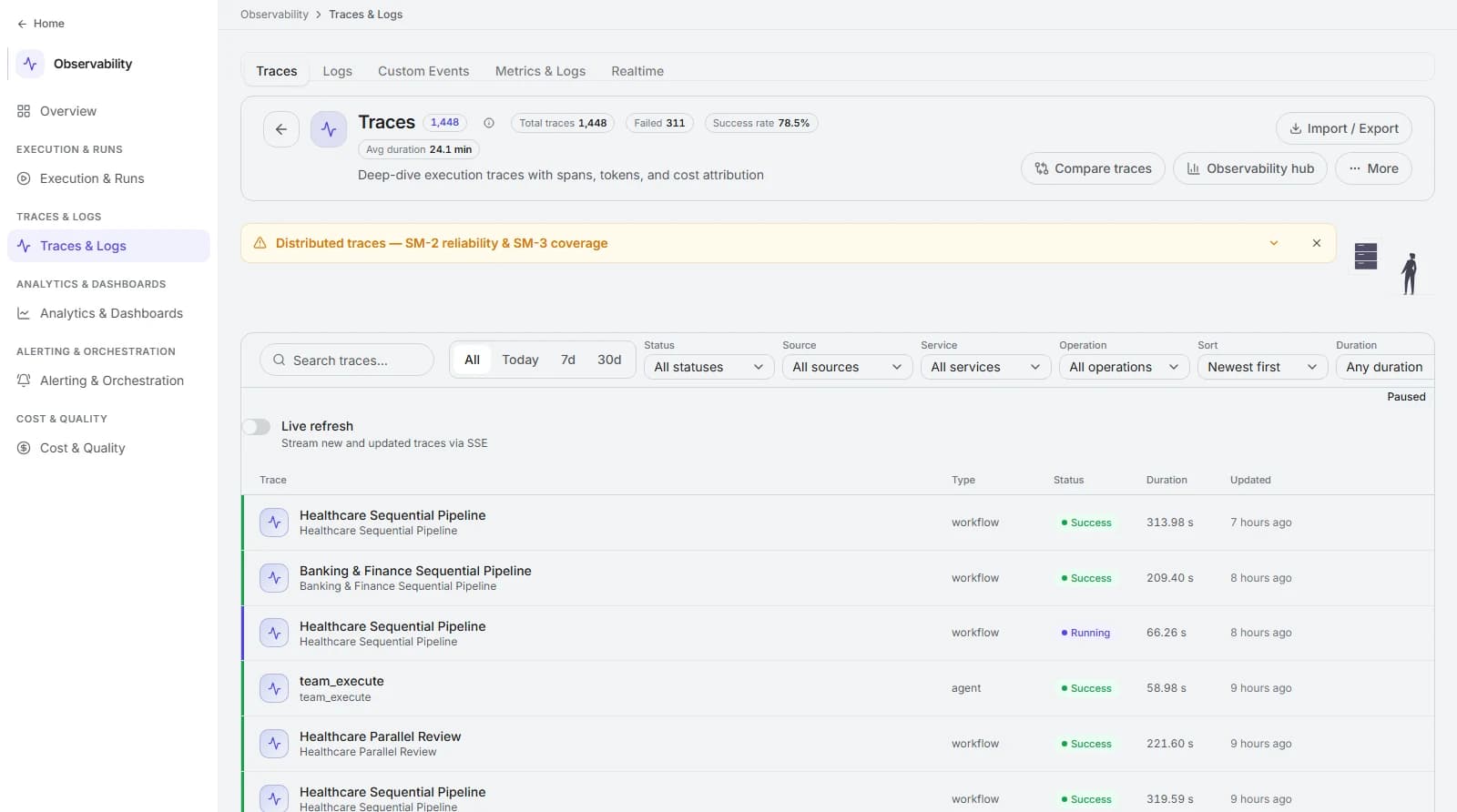
Every run, traced end to end.
1,448 traces with duration, status, and cost attribution - filter by status, source, service, and operation, or stream new runs live.
The return
Value that survives an audit committee.
Baseline from your current service data. Every metric below is a calculation over your own runs - nothing is asserted on your behalf.
Cost per enquiry
(officer minutes × loaded rate) + platform cost ÷ enquiries handled
Report the platform cost line explicitly. An audit committee will ask for it, and having it attributed per run is the difference between a saving and an assertion.
Backlog days
open cases ÷ average cases cleared per day
The number that appears in performance reporting. Assembly time is usually the constraint, which is what Bhogar removes.
First-contact resolution
enquiries resolved at first contact ÷ total enquiries
Repeat contact is pure avoidable cost and the clearest signal of inconsistent answers across channels.
Appeal and complaint rate
appeals or complaints upheld ÷ decisions issued
Watch this as a guardrail rather than a savings metric. Consistent, cited reasoning should hold it flat or lower; any rise warrants review before scaling.
| Dimension | Before | With Bhogar |
|---|---|---|
| Answering a citizen enquiry | Channel-specific scripts produce different answers to the same question. | One cited answer from the controlling source, consistent across every channel. |
| Preparing a case | Officers gather evidence and check policy versions by hand. | The file arrives mapped to the criteria with gaps listed explicitly. |
| Making the determination | Judgment applied under time pressure with variable reference material. | Judgment applied by the same officer, with the applicable rules already surfaced and recorded. |
| Responding to oversight | Reasoning reconstructed from case notes and recollection. | Sources, drafts, edits, and the approving officer available per case. |
FAQ
Frequently asked questions
Will this make decisions about people’s entitlements?
Can it be deployed in our own jurisdiction and infrastructure?
How do you meet accessibility obligations?
How do we handle freedom-of-information requests about the system itself?
Keep exploring
Financial services
safe answers and case work across core banking, KYC files, complaints, and the policy library - with an evidence trail supervisors and auditors accept.
Healthcare
Give administrative hours back to clinical and access teams - prior authorisation, payer policy, denials, and patient access answered from your approved sources.
Retail
Answer order, returns, and product questions from live systems instead of a stale help centre - and hold cost per contact flat through peak.
Start with your highest-volume enquiry type.
We will scope the source corpus, the accountability model, and the accessibility acceptance criteria with your service and assurance teams.