Use case · Use case - Legal & commercial
Contract & document analysis
Contracts, policies, and supplier agreements contain obligations nobody has inventoried since signature. BhogarAI extracts them at clause level against your own playbook, flags deviations with the exact text, and leaves the judgment where it belongs.
ROI lever
Review cycle time and cost per document
Document review scales linearly with headcount and nothing else, which is why the backlog never clears. Extraction and comparison are mechanical; judgment is not. Automating the first makes the second affordable at volume.
Reads from
- Executed agreements
- Clause playbook
- Redlines and negotiation history
- Policies and control standards
The problem
You signed the obligations. You just cannot list them.
Legal and commercial teams are asked questions their document set can answer - which contracts have this indemnity cap, which auto-renew next quarter, which restrict this data processing - and answering them means someone reading everything again.
Checked by hand today
- Executed contracts and amendments
- Clause playbook and standards
- Negotiation history and redlines
- Signature and CLM systems
- Policies and control standards
- Supplier and customer records
““Which of our agreements deviate from the standard position on this clause, and by how much?””
Review time scales with page count
Every incoming agreement is read end to end because there is no reliable way to know in advance which clauses deviate from your standard position. Volume becomes a queue and the queue becomes a bottleneck on revenue.
The executed set is not inventoried
Obligations, renewal dates, liability caps, and data-processing terms sit in signed PDFs. Portfolio questions require a manual review project each time they are asked.
Standards are applied inconsistently
Different reviewers accept different deviations under deadline pressure. Without clause-level records, nobody can see the pattern until a dispute exposes it.
How Bhogar helps
How Bhogar handles contract & document analysis
Long documents are segmented by structure rather than chopped by character count, so a clause and its sub-clauses, definitions, and cross-references stay together and the extraction has the context it needs.
Sources
- Executed agreements
- Clause playbook
- Redlines and negotiation history
- Policies and control standards
Outcomes
- Clause-level extractions
- Deviation reports
- Obligation and renewal registers
- Reviewed, recorded decisions
Structure-aware extraction
Documents are parsed into their real hierarchy - clauses, schedules, annexes, defined terms - so findings cite a clause number and page rather than an arbitrary text fragment.
How it works →Deviation against your playbook
Your standard positions and fallback ladder are encoded once. Each agreement is compared to them and the output states the deviation, its direction, and the quoted text.
How it works →Portfolio-level questions
Once the set is extracted, questions about renewal exposure, liability caps, or processing restrictions are queries over structured findings instead of new review projects.
How it works →Reviewable output, always
Findings are proposals with citations. A qualified reviewer accepts, amends, or rejects each one, and the decision is recorded - the platform never signs anything.
How it works →
All your data
Your documents, your playbook, your privilege boundary.
Legal content is among the most sensitive in the company. Retrieval scopes are explicit, privileged material is segregated, and nothing is used to train a shared model.
Executed agreements
Master agreements, orders, schedules, amendments, and side letters, linked so the operative terms are read together.
Clause playbook and standards
Preferred positions, acceptable fallbacks, approval thresholds, and the escalation matrix that decides who signs off a deviation.
Negotiation record
Redlines, counterparty positions, and prior concessions, so the team can see what has actually been conceded before.
Contract lifecycle systems
Metadata, status, counterparties, renewal dates, and the owning commercial contact for each agreement.
Policy and control standards
Internal policies the agreement must comply with - data protection, security commitments, insurance, delegated authority.
Counterparty context
Supplier or customer records that determine which standard applies, including risk tier and prior dispute history.
Governance built in
- Privileged and dispute-related material held in separate scopes with explicit grants, never inherited by default.
- Findings presented as citations to source text - a reviewer can always see the exact clause behind a conclusion.
- No customer document content used to train shared models; retention at the provider disabled or bounded by contract.
- Approval thresholds from your delegated-authority matrix enforced as workflow gates rather than convention.
- Complete record of what was extracted, what a reviewer changed, and who approved each deviation.
The workflow
An incoming agreement, triaged in minutes.
The same pipeline runs in bulk across an executed portfolio when you need an obligation register rather than a review.
A document arrives for review
From the CLM system, a shared mailbox, or a bulk load of the executed set, with counterparty and agreement type identified.
In the portal
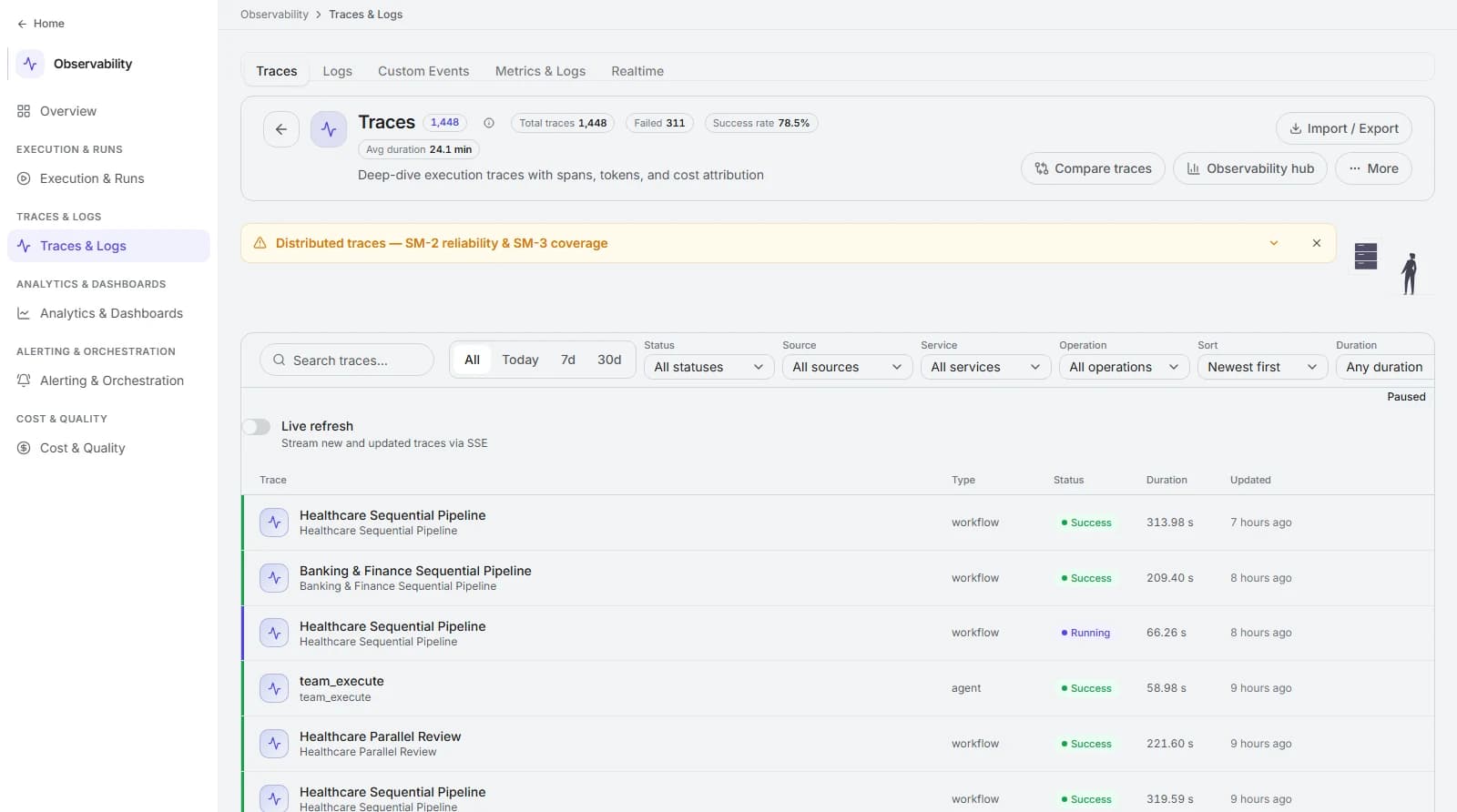
Every run, traced end to end.
1,448 traces with duration, status, and cost attribution - filter by status, source, service, and operation, or stream new runs live.
The return
Cost per document, and the deals it unblocks.
Baseline your current review time by document type. The second-order benefit - faster contracting cycles - is usually larger than the labour saving and worth measuring separately.
Review cycle time
median hours from document received to review complete
Segment by agreement type. A one-page order form and a master agreement do not belong in the same average.
Cost per document reviewed
(reviewer hours × loaded rate) + platform cost ÷ documents
Include external counsel spend in the baseline where routine review is currently outsourced - that is often the largest line.
Extraction accuracy
findings accepted without amendment ÷ total findings
Measured continuously from reviewer decisions, which makes it a real quality signal rather than a benchmark from a vendor deck.
Obligation coverage
agreements with a current extracted register ÷ total agreements
Portfolio questions are only answerable over the covered set. This number is your honest answer to “do we know what we signed”.
| Dimension | Before | With Bhogar |
|---|---|---|
| Reviewing an incoming agreement | Read the whole document to find the clauses that deviate. | Review a ranked exception list with quoted text and clause references. |
| Portfolio questions | A manual review project every time the question is asked. | A query over extracted, cited findings. |
| Consistency | Different reviewers accept different deviations under deadline. | Every deviation compared to one playbook and recorded. |
| Renewal exposure | Discovered when the renewal notice period has already passed. | Tracked from an extracted register with dates and owners. |
FAQ
Frequently asked questions
Is this legal advice?
How accurate is extraction on unusual agreements?
Can we run it across contracts we signed years ago?
Will our documents be used to train models?
Keep exploring
Account briefing
Give every seller a current, cited account brief before every meeting - assembled from CRM, product usage, support history, and your own documents.
Onboarding
Make new joiners self-sufficient faster - role-scoped answers from policy, systems, and team documentation, plus the provisioning workflow behind it.
Reporting
Turn recurring reports into a safe workflow - numbers queried from the warehouse, narrative drafted, variances explained, owner approves.
Bring ten agreements and your playbook.
We will extract them against your standard positions and you can grade the findings yourself before anything else is discussed.